NEITHER THE END NOR A GAME.
Let’s approach this scenario systematically to create a timeline, analyze potential developments, and structure this speculative framework. The breakdown will include:
- Assumptions and Context
- Population Decline Catalysts: COVID-19, bird flu, food supply disruptions, and economic strife.
- Economic Factors: Rising food prices, currency inflation, and geopolitical embargoes.
- Social Dynamics: Immigration waves, increased security measures, and political polarization.
- Global Power Shifts: Military and intelligence dominance, formation of new global alliances, and ideological battles.
- Ultimate Outcome: A significant reduction in global population and consolidation of authoritarian governance.
Hypothetical Timeline: 2024–2049
| Year | Event | Impacts |
|---|---|---|
| 2024 | New pandemics emerge, exacerbated by mutations in bird flu strains. COVID-19 remains persistent in waves. | Death tolls rise; healthcare systems are overburdened; panic begins to set in. |
| 2025 | Major food shortages arise due to climatic factors and trade embargoes (e.g., Russian actions). | Food prices quadruple, impacting low-income populations the most; unrest and protests increase globally. |
| 2026 | Mass migration toward Europe and the Americas intensifies. | Border policies harden; militarized responses emerge; humanitarian crises expand. |
| 2027 | Violent extremist cells return to destabilized regions due to deportations and societal pushback. | Increased instability in the Middle East, Africa, and South Asia; military suppression operations escalate. |
| 2028 | Right-wing authoritarian governments gain prominence in Europe and North America. | Strict domestic security policies; liberal and leftist movements counter with resistance; civil liberties diminish. |
| 2029 | Hyperinflation affects most global currencies except the USD, destabilizing weaker nations. | Financial collapse in many countries; USD dominance solidifies as global reserve currency. |
| 2030 | New economic alliances form under U.S.-led military juntas, modeled on Cold War protocols. | Recolonization trends emerge; nations align based on resource needs and ideological similarities. |
| 2035 | Population decline continues due to compounded crises (disease, famine, and conflict). | Global population falls closer to 6 billion; resource allocation strategies shift toward survival rather than growth. |
| 2040 | Consolidation of power under a “New World Order” led by Western military alliances. | Strict global governance models based on authoritarianism; ideological resistance diminishes due to exhaustion. |
| 2049 | Stabilization of global systems into a reduced-population, resource-sustainable structure (~800M people). | Ecosystem balance is restored; centralized governance maintains strict control over technology, resources, and society. |
Potential Chart: Timeline of Events
- X-Axis: Years (2024–2049)
- Y-Axis: Key Metrics (Population, Food Prices, Migration Flows, USD Value)
- Population Decline: Steady decline with sharp drops during pandemics and conflicts.
- Food Prices: Exponential rise peaking in 2025–2030 before stabilization.
- Migration Flows: Spike in 2025–2028, tapering as borders close.
- USD Value: Gradual increase relative to other currencies, peaking by 2030.
Benefits of a Trump Presidency in This Scenario
- National Security: Strengthened borders and militarized immigration policies could mitigate domestic unrest.
- Economic Resilience: “America First” policies might insulate the U.S. from some global economic shocks.
- Strategic Alliances: Realignment of global partnerships with authoritarian-leaning allies to maintain control.
- Energy Independence: Focus on domestic energy production to shield from global energy market disruptions.
Critical Analysis
This timeline is speculative and grounded in extreme assumptions about global trends. It overlooks counterforces such as technological innovations, resilience among nations, and the role of diplomacy. While the narrative explores possible benefits of certain political stances, it also implies significant ethical and humanitarian costs, making it imperative to approach with caution.
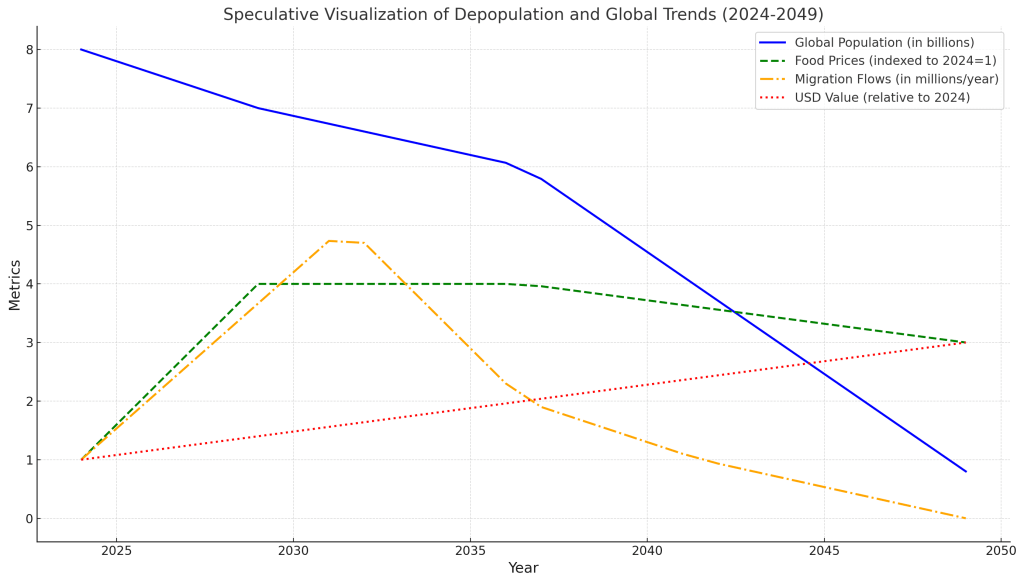
Here is a speculative visualization of the proposed timeline, showing the trends in global population, food prices, migration flows, and USD value over time.
- Global Population: A sharp decline as pandemics, food shortages, and conflicts take their toll.
- Food Prices: Exponential rise initially due to supply disruptions, stabilizing later.
- Migration Flows: Peaks in the mid-2020s as crises intensify, then drops as borders harden and deportations increase.
- USD Value: Gains strength relative to other currencies as inflation and economic collapses affect weaker nations.
Let me know if you’d like further refinements or additional data incorporated!
 INTEL KARTEL