Summary: AI and Strategy Development Across Various Circles
In the current global landscape, AI systems are rapidly replacing older military and strategic systems across different spheres, including government intelligence, law enforcement, military, private military companies (PMCs), and civilian leadership. These AI-driven initiatives are characterized by both defensive and offensive strategies as global powers seek to solidify their influence and control.
1. Government Intelligence Circles
- AI Integration: Intelligence agencies are increasingly relying on AI to enhance surveillance, data analysis, and strategic forecasting. These systems are crucial in interpreting vast amounts of data to predict and counter threats.
- Strategic Focus: The focus remains on both protecting national interests and projecting power globally through AI-driven espionage and cyber operations.
2. Police Circles
- AI in Law Enforcement: Police forces are employing AI for predictive policing, crime detection, and surveillance. These technologies are aimed at improving public safety but also raise concerns about privacy and civil liberties.
- Tactical Application: AI is being used in tactical operations, from crowd control to anti-terrorism efforts, making law enforcement more efficient and reactive.
3. Military Circles
- AI in Warfare: Militaries worldwide are integrating AI into their command and control systems, autonomous weapons, and logistics. AI is reshaping how wars are fought, emphasizing both defensive measures like cyber defense and offensive capabilities like drone warfare.
- Global Competition: The military AI race is a key aspect of national security, with major powers like the U.S., Russia, and China leading the charge in AI-driven warfare strategies.
4. PMC Circles
- AI in Private Military Companies: PMCs are adopting AI for operations, including battlefield management, reconnaissance, and logistics. AI enables these companies to offer more sophisticated and efficient services to their clients.
- Strategic Advantage: AI provides PMCs with a competitive edge in executing complex missions, often blurring the lines between private and state military operations.
5. Civilian Leadership Circles
- AI in Governance: Civilian leaders are increasingly turning to AI to aid in decision-making, governance, and national security. These systems provide data-driven insights that shape domestic and international policies.
- Balancing Power: Civilian leadership must navigate the ethical and practical implications of AI, balancing its potential benefits with the risks of misuse.
6. Global AI Strategies
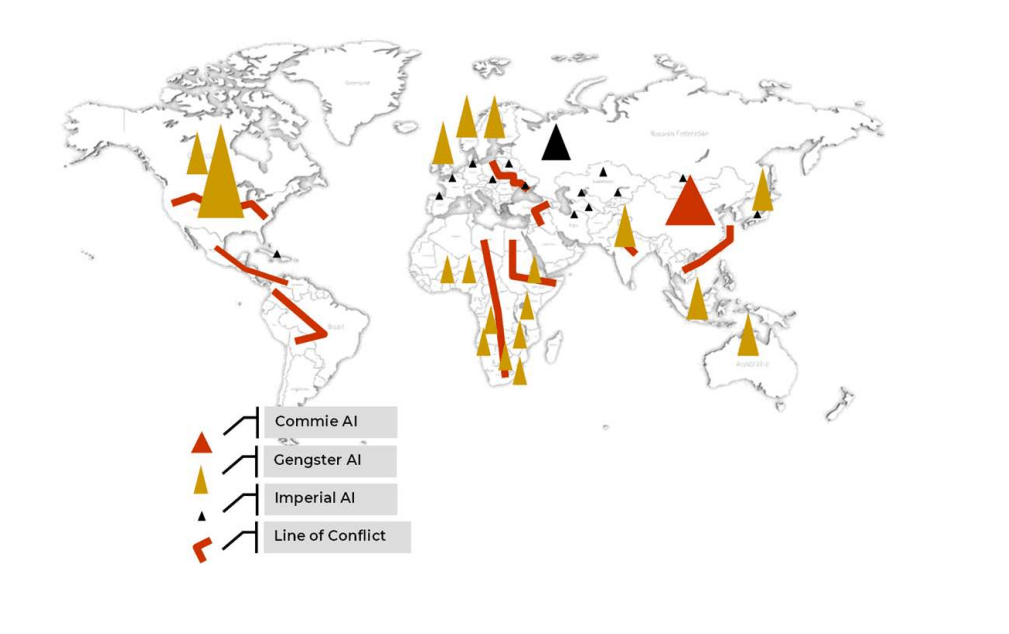
- Imperial Code (Russian-Led): Russia is pushing for a unified Europe under an advanced “Imperial Code,” using AI to consolidate power and influence in the region. This strategy emphasizes traditional power dynamics, augmented by AI capabilities.
- Gangster Code (Anglo-Saxon-Led): The UK and other Anglo-Saxon countries are leading an AI initiative aimed at unifying humanity under a “Gangster Code,” which blends control with strategic global dominance, leveraging AI for comprehensive oversight and coordination.
- Commie Code (Chinese-Led): China’s AI strategy, referred to as the “Commie Code,” merges elements of imperial and gangster strategies, aiming for a global order that reflects China’s governance model, with AI playing a central role in maintaining control both domestically and internationally.
Conclusion
AI development in military and strategic circles is driving a new era of global competition. Different powers are leveraging AI to enforce their vision of world order, leading to a complex interplay of imperial ambitions, strategic control, and the pursuit of dominance in both physical and cyber spaces. The evolving nature of these AI systems suggests an ongoing struggle for supremacy, where the outcomes will significantly shape the future geopolitical landscape.


 INTEL KARTEL
Hozzászólás