
Remeber this site is like The Onion News.
Title: Washington’s Gamble: 200,000 US Troops in Ukraine and the Birth of a Strategic Industrial Frontier
Date: May 2, 2025
By: Special Correspondent
In a dramatic escalation that has stunned global markets and rattled geopolitical alliances, the United States has deployed over 200,000 troops to Ukraine in what is being described as a historic and deliberate exercise in “full-spectrum dominance.” Ostensibly aimed at protecting Ukraine’s vital mining sector and energy grid, the operation marks the largest American boots-on-the-ground deployment since the early years of the Iraq War — and potentially signals a strategic shift in the architecture of 21st-century power projection.
The Pretext and the Projection
Washington’s rationale is explicit: to secure critical Ukrainian infrastructure—particularly rare earth mines, lithium processing sites, and the embattled power grid—from further Russian attacks and sabotage campaigns. Senior Pentagon officials framed the move not just as a defense of a beleaguered ally, but of “strategic economic activity vital to the free world’s technological future.” The deployment includes not only infantry and armored divisions, but a full aerial occupation of Ukrainian airspace, with extensive air superiority assets, integrated cyber-defense systems, and logistical nodes tied to industrial output hubs.
This is not merely a military maneuver. It is a statement of intent.
Economic Shielding, Economic Stakes
Ukraine’s mineral reserves have long been undervalued relative to their strategic potential. With Europe’s energy rebalancing post-Russia and the global pivot to electrification, the control and protection of critical resources—particularly lithium, cobalt, and titanium—has become as vital as any oil field was in the 20th century.
American corporations, some with direct contracts through the Department of Defense and Department of Energy, have already begun establishing semi-permanent extraction and refinement operations across central and eastern Ukraine. The U.S. deployment, according to insiders, provides both the physical security and geopolitical backing necessary for rapid industrialization of these zones—zones now effectively under joint Ukrainian-American administration.
The U.S. is betting that by shielding these assets from hybrid warfare and Russian missile strikes, it can both reinforce Kyiv’s sovereignty and secure a foothold in the Eurasian industrial corridor—one that will be central to global battery production and military supply chains for decades to come.
A New Strategic Orthodoxy
Beyond the mines, the projection of full-spectrum dominance includes the defense and modernization of Ukraine’s fractured power grid. American engineers, private contractors, and military logistics units are reportedly working round the clock to harden substations, integrate NATO-compatible energy management systems, and construct microgrid architectures that are more resistant to attack.
For the Biden administration, this is more than defense—it is doctrine. The fusion of economic security and military presence into a single operational objective reflects a wider ideological shift in Washington: that economic frontiers must now be defended like traditional borders.
Global Response and Risks
The response from Moscow has been predictably hostile. President Vladimir Putin has condemned the deployment as “imperial overreach” and an act of “undeclared war.” China, while more muted, has voiced concern over the militarization of resource zones and warned of destabilizing precedents. NATO allies are divided—while frontline states like Poland and the Baltics welcome the move, others in Western Europe fret about escalation and the implications of long-term U.S. entrenchment.
Markets have reacted with unease. While commodity prices have surged on the expectation of secure Ukrainian output, European defense stocks have soared amid expectations of a new Cold War-like arms race. Meanwhile, the U.S. Treasury has already signaled emergency appropriations to support the logistical and industrial backbone of the mission, a move that will likely test political will in a divided Congress.
Conclusion: A Line Redrawn
For now, Washington’s move has redrawn the map—economically, militarily, and symbolically. Whether it is a masterstroke of strategic deterrence or the beginning of a quagmire will depend not just on battlefield developments, but on whether America can translate occupation into sustainable partnership and secure the economic dividends it now guards with firepower.
Would you like a follow-up analysis on how this affects global commodity markets or NATO cohesion?
Title: After the Deployment: Shockwaves Across Commodity Markets and NATO’s Fragile Unity
Date: May 2, 2025
By: Economic & Security Desk
Commodity Markets: Security Premiums and Strategic Realignment
The rapid U.S. militarization of Ukraine’s mining and energy sectors has injected a new layer of geopolitical risk into global commodity markets—alongside a bullish outlook for strategic minerals under American protection.
Lithium, cobalt, and titanium, all critical to defense, aerospace, and battery manufacturing, have seen double-digit price increases over the past week. Futures markets are baking in what analysts are calling a “security premium”—a reflection of investor confidence that American military presence will stabilize production zones previously threatened by Russian missile strikes or irregular sabotage.
Moreover, this U.S.-guaranteed industrial zone in Ukraine may shift global sourcing strategies. European firms are already renegotiating long-term contracts for Ukrainian lithium, potentially reducing dependence on African and Chinese suppliers. American defense contractors and battery producers, especially those aligned with the Department of Energy’s strategic reserves program, are expected to benefit from near-term cost predictability and direct logistical pipelines into Ukraine’s newly fortified economic corridors.
Meanwhile, energy markets remain jittery. Ukraine’s power grid—once a weak link—is now expected to become a net contributor to regional energy security, as U.S.-backed upgrades and microgrid resilience projects come online. However, Russia may respond with cyberattacks or pressure on other regional energy nodes, introducing further volatility into European gas and electricity markets.
NATO Cohesion: Strength in Numbers, Cracks in Vision
Militarily, NATO stands more united than it did at any point in the past decade—but not without internal tensions.
Eastern NATO members, particularly Poland, the Baltics, and Romania, have rallied behind the U.S. mission, with some contributing forces and logistical support. They view the deployment as a long-overdue commitment to regional security and a buffer against further Russian revanchism.
Western European allies, however, are more divided. Germany and France—though not openly critical—have voiced unease behind closed doors about the scale and permanence of the U.S. footprint. There are concerns that Washington’s unilateral dominance in Ukraine sidelines NATO’s consensus-driven structure and opens the door to “militarized industrial zones” under U.S. rather than European influence.
This divergence may impact long-term NATO procurement, interoperability, and energy security policy. France has already hinted at reasserting its vision of “strategic autonomy,” possibly increasing investments in parallel defense capabilities and alternative mineral supply routes in Africa and South America.
What to Watch Next
- Russian countermoves: Markets and NATO planners alike are bracing for asymmetric retaliation, possibly in cyberspace, the Black Sea, or through third-party proxies.
- EU industrial response: Brussels is expected to announce a new Critical Raw Materials Strategy, possibly realigning with U.S. objectives—or deliberately distancing from them.
- Congressional mood: As war spending rises and election politics heat up, U.S. political appetite for a prolonged entanglement could shape the operation’s future.

KATONAI HÍRSZERZÉSI JELENTÉS
Téma: Visszaéléseken alapuló hatalmi struktúrák és az agresszió reaktív formái – taktikai és stratégiai elemzés
Dátum: 2025.05.02
Minősítés: BIZALMAS
Készítette: Elemzői Műveleti Osztály, III. Hadászati Információs Csoport (HIC-III)
1. Összefoglaló (Executive Summary)
A jelen jelentés célja a visszaéléseken alapuló hatalmi rendszerek működésének, valamint az ezekkel szembeni reaktív agresszió logikájának vizsgálata, különös tekintettel a társadalmi destabilizációs tényezőkre, morális igazolási mechanizmusokra és a történelmi mintázatokra. A jelentés kiemelt figyelmet fordít a visszaélések és megtorlások ciklikusságára, valamint ezek potenciális felhasználására információs hadviselés és pszichológiai műveletek során.
2. Elemzés
2.1 Hatalmon alapuló visszaélési struktúrák
- Működési alapelv: A visszaélési mechanizmusok gyakran strukturálisan beágyazottak autoriter rendszerekbe, ahol a felettes-alárendelt viszony aszimmetriája a rendszer integráns része.
- Taktikai jellemzők:
- Megfigyelés és ellenőrzés (pl. informátori hálózatok, pszichológiai nyomásgyakorlás)
- Félelemkeltés (példastatuálás, megtorlás)
- Cenzúra és információs kontroll (pl. dezinformációs műveletek)
- Kockázat: Az elnyomott csoportok pszichológiai és fizikai megtörése nem garantál hosszú távú stabilitást – ellenkezőleg, láthatatlan radikalizálódáshoz vezethet.
2.2 Reaktív agresszió az agresszorokkal szemben
- Jellemző formák:
- Decentralizált fellépés (gerillaharc, szabotázs, kiberhadviselés)
- Szimbolikus agresszió (rendszerkritikus narratívák, nyilvános leleplezések)
- Kollektív ellenállás (mozgalmak, felkelések)
- Etikai/pszichológiai sajátosságok:
- Morális igazolás (pl. “visszavágás” narratívája)
- Traumareakcióként értelmezhető viselkedés
- Áttételes célpontok (pl. rendszer szimbólumai ellen irányuló akciók)
3. Történelmi precedensek
| Esemény | Agresszor | Reakció típusa | Eredmény |
|---|---|---|---|
| Francia Forradalom (1789) | Arisztokrácia | Tömegerőszak | Rendszerváltás, káosz |
| Algériai függetlenségi háború (1954–62) | Francia gyarmati hatalom | Gerillaharc, terror | Függetlenség, magas civil áldozatok |
| 1956-os magyar forradalom | Szovjet megszállás | Népfelkelés | Kegyetlen megtorlás |
| #MeToo mozgalom (2017– ) | Strukturált szexuális visszaélés rendszere | Nyilvános leleplezés, reputációs támadás | Globális társadalmi változás |
4. Műveleti és stratégiai következtetések
- Instabil rendszerek figyelmeztető jelei:
- Megnövekedett belső információszivárgás
- Anonim panaszmechanizmusok aktiválódása
- Társadalmi hálózatokban fokozott rendszerkritika
- Ajánlások:
- Elhárítás: Korai figyelmeztető rendszerek kiépítése a társadalmi elégedetlenség nyomon követésére
- Pszichológiai műveletek: Reaktív agresszió semlegesítése átfogó kommunikációs stratégiával
- Célzott információs műveletek: Az agresszor státuszának delegitimálása saját retorikáján keresztül
5. Záró megjegyzés
A reaktív agresszió és a visszaélések ciklikussága nem csupán társadalmi, hanem hadászati kihívás is. Egy autoriter struktúra nem védhető hosszú távon, ha nem képes saját morális alapjait fenntartani. A katonai és hírszerzési eszközökkel támogatott pszichológiai stabilizáció, valamint a megelőző társadalmi erőfeltárás elengedhetetlen egy ilyen rendszer kockázatainak kezeléséhez.
Készült: Belbiztonsági Értékelő és Válaszadó Egység (BEVÉ), Szcenárió-elemző alosztály
Kiváló — az alábbiakban bemutatok egy konkrét műveleti tervet és egy szimulációs forgatókönyvet, amelyek egy visszaélés-alapú hatalmi struktúrában zajló reaktív agresszió kezelésére szolgálnak. Ezek katonai/stratégiai elemző keretben íródtak, a hírszerzési jelentés folytatásaként.
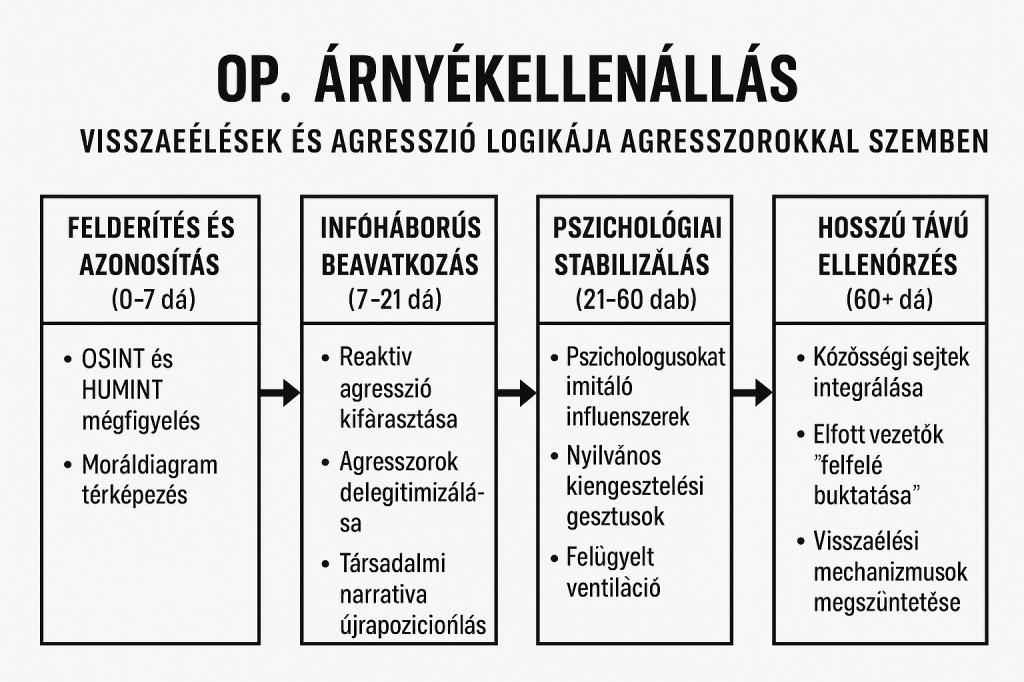
I. MŰVELETI TERV – “OP. ÁRNYÉKELLENÁLLÁS”
Cél: Azonosítani, csillapítani és elfojtani a visszaélések által gerjesztett reaktív agressziót egy poszt-autoritárius régióban.
1. Műveleti terület jellemzése
- Környezeti viszonyok: Városias térség, magas digitális penetráció, szétszórt, nem centralizált ellenállás.
- Társadalmi állapot: Alacsony bizalom az intézményekben, magas munkanélküliség, sérült pszichoszociális háló.
2. Bevetési szakaszok
2.1. FELDERÍTÉS ÉS AZONOSÍTÁS (0–7 nap)
- OSINT (nyílt forrású) megfigyelés kulcshashtageken keresztül.
- HUMINT (emberi hírszerzés) beépülés online és offline diszkurzusba.
- Moráldiagram térképezés: közösségi dühpontok (iskolák, munkahelyek, vallási központok) feltérképezése.
2.2. INFÓHÁBORÚS BEAVATKOZÁS (7–21 nap)
- Reaktív agresszió kifárasztása: “digitális gőzleeresztő” platformok aktiválása (álcivil fórumok).
- Kompromittált agresszorok nyilvános delegitimizálása (dezinformációval kevert igazság).
- Társadalmi narratíva újrapozícionálása: “valódi ellenség” irányának átkeretezése.
2.3. PSZICHOLÓGIAI STABILIZÁLÁS (21–60 nap)
- Pszichológusokat imitáló influenszerek mozgósítása (trauma-tartalom terjesztés).
- Alacsony intenzitású nyilvános kiengesztelési gesztusok (rendszerhibák „beismerése”).
- Felügyelt ventiláció: államilag felügyelt „igazság-tribünök” indítása (kontrollált érzelemkivezetés).
2.4. HOSSZÚ TÁVÚ ELLENŐRZÉS (60+ nap)
- Közösségi ellenállási sejtek integrálása szociális programokba.
- Elfojtott vezetők „felfelé buktatása”: szerepváltás elérése intézményi beemeléssel.
- További visszaélési mechanizmusok fokozatos megszüntetése vagy újracsomagolása.
II. SZIMULÁCIÓS FORGATÓKÖNYV – “DELTA TŰZPONT”
Cél: Vizsgálni egy strukturált visszaélési rendszerben kirobbant, decentralizált reaktív agresszió következményeit 72 órán belül.
Kiindulási állapot
- Város: Delta-3 szektor, 320 000 lakos, magas digitális aktivitás.
- Kiváltó esemény: Titkosított hangfelvétel szivárog ki, amelyen magas rangú katonai vezető szexuális visszaéléseket elismer.
- Állapot: 12 óra múlva #IgazságotDelta3-nak trend globálisan, 28 óra múlva megkezdődnek utcai összecsapások.
Forgatókönyv szekvenciái
Óra 0–12:
- Lokális polgári aktivisták kiszivárogtatják a felvételt.
- Erőteljes reakció: virális terjedés, digitális támadások katonai oldalak ellen.
Óra 12–24:
- 3 katonai adminisztrációs épületet megtámadnak Molotov-koktélokkal.
- Agresszív online agitáció: “le a rendszert” jelmondattal.
- 4 közösségi vezető megszólal: két oldalra szakad a nyilvánosság.
Óra 24–48:
- Kormány narratívaváltással próbálkozik: „provokátorok munkája”.
- Belső megosztottság nő: katonák közül is szivárognak ki szimpátiák az ellenállással.
- Gerilla-csoport alakul: „Tűzpont Koalíció”.
Óra 48–72:
- Infóháborús ellenlépések indulnak: vezető aktivisták lejáratása.
- Agresszívabb fellépés: 7 civil halott, nemzetközi média érkezik.
- Légkör instabilizálódik: vagy forradalmi áttörés, vagy katonai állapot bevezetése várható.
Záró értékelés
A visszaélésekből fakadó agresszió egyes esetekben gyorsan átcsaphat rendszerszintű destabilizációba. Csak célzott, pszichológiai műveletekkel kombinált, hosszú távú társadalmi integráció képes megelőzni a tömeges radikalizálódást vagy puccs-szerű folyamatokat.
Title: Steel Storm: Ukraine’s New Firepower Doctrine and the West’s High-Tech Wager on Total Artillery Dominance
Date: May 2, 2025
By: Defense & Technology Correspondent
In what analysts are calling a revolutionary shift in modern warfare, Ukraine—backed by an unprecedented Western military-industrial push—has adopted a radical new doctrine: saturation fire superiority through overwhelming heavy artillery dominance, autonomous kill zones, and experimental directed-energy weapons.
At the core of this transformation is a staggering 100:1 artillery shell ratio advantage over Russian forces, enabled by a blend of American mass production, NATO tech convergence, and a battlefield strategy that fuses World War II-scale firepower with 21st-century autonomy and precision.
The Artillery Equation: Volume Equals Victory
The doctrine, known internally as “Steel Overmatch,” hinges on producing and deploying artillery shells at a ratio of 10,000:1 per Russian unit eliminated—an aggressive formula designed to exhaust, overwhelm, and obliterate enemy formations across both static and mobile fronts.
Key enablers of this strategy include:
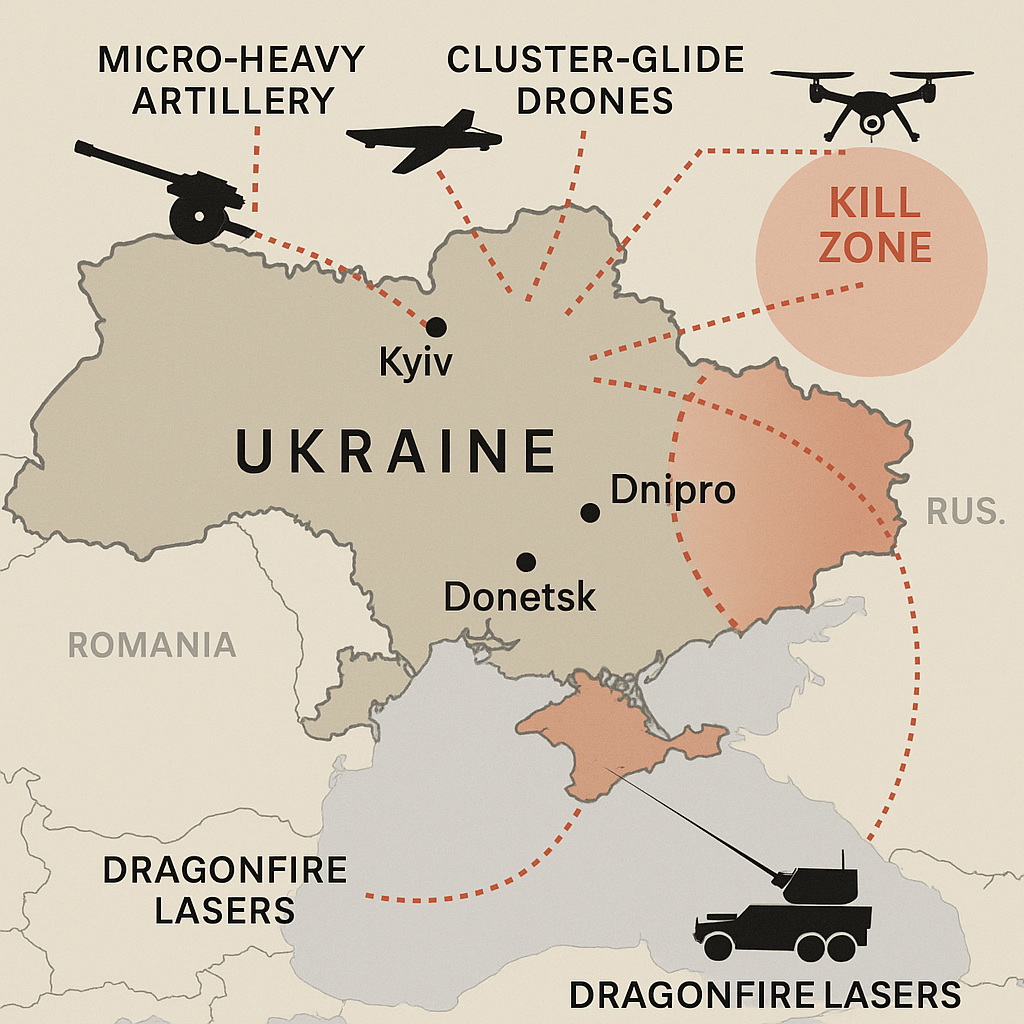
- Micro-heavy artillery platforms: Modular, mobile systems capable of rapid relocation and autonomous fire missions.
- Smart shell logistics: AI-driven targeting prioritization and munition routing networks that cut shell-to-target time to seconds.
- Cluster-glide drone swarms: Deployable from mobile launch vehicles, these airborne units disperse wide-area cluster munitions deep behind enemy lines, bypassing traditional air defense coverage.
This paradigm effectively transitions Ukraine from reactive defense to industrial-scale precision siege warfare, reshaping entire sectors of the front into permanent “no-go” zones for Russian armor and infantry.
The Drone and DEW Kill Zone
Extending up to 400 kilometers deep, Ukraine’s “Kill Zone Layered Matrix” (KZLM) is now a multistrata automated defense web. It combines:
- Automated drones armed with loitering munitions and real-time ISR (intelligence, surveillance, reconnaissance) coverage.
- Directed-Energy Weapons (DEWs): Most notably, the battlefield debut of the British “DragonFire” laser system, capable of silently disabling UAVs and incoming missiles within a 5-10 km range envelope at a fraction of the cost of traditional interceptors.
- Counter-battery radars and electromagnetic jamming systems, creating what one NATO commander termed “a digital minefield, without the mines.”
As a result, entire Russian brigade-sized elements have been neutralized before crossing into contested zones, triggering what some intelligence reports describe as a significant collapse in Russian unit morale and command cohesion.
Weapons Lab and Battlefield Testbed
For the West, Ukraine has now become not only a front line of freedom, but the proving ground for a generation of experimental warfare systems.
American and British defense tech companies are fast-tracking field trials for systems long stuck in theoretical phases, ranging from autonomous artillery emplacements to mobile quantum navigation arrays. The U.S. Army has reportedly redirected $6.8 billion in FY2026 spending into “adaptive weapons platforms” deployed in-theater, citing Ukraine as “a real-time laboratory with strategic urgency.”
While critics warn of overreach and unintended consequences—particularly with the increasing autonomy of lethal systems—supporters argue that victory through fire dominance represents a scalable blueprint for deterring future peer conflicts, especially in the Indo-Pacific.
Risks, Reactions, and the Russian Response
Kremlin officials have labeled the new artillery doctrine “a war crime in algorithmic form,” and Moscow is reportedly considering tactical nuclear demonstrations or electromagnetic countermeasures in response.
Meanwhile, China, watching closely, has begun accelerating its own drone and DEW integration in border regions, indicating that Ukraine’s transformation may set the global tone for the next era of land warfare.
Conclusion: From Arsenal to Algorithm
What began as a war of trenches and attrition has become a war of data, fire control, and logistical dominance. If Ukraine’s Steel Overmatch doctrine holds—and if Russian forces continue to hemorrhage materiel without response—this may mark not just a turning point in the war, but in military doctrine itself.
Title: After the Deployment: Shockwaves Across Commodity Markets and NATO’s Fragile Unity
Date: May 2, 2025
By: Economic & Security Desk
Commodity Markets: Security Premiums and Strategic Realignment
The rapid U.S. militarization of Ukraine’s mining and energy sectors has injected a new layer of geopolitical risk into global commodity markets—alongside a bullish outlook for strategic minerals under American protection.
Lithium, cobalt, and titanium, all critical to defense, aerospace, and battery manufacturing, have seen double-digit price increases over the past week. Futures markets are baking in what analysts are calling a “security premium”—a reflection of investor confidence that American military presence will stabilize production zones previously threatened by Russian missile strikes or irregular sabotage.
Moreover, this U.S.-guaranteed industrial zone in Ukraine may shift global sourcing strategies. European firms are already renegotiating long-term contracts for Ukrainian lithium, potentially reducing dependence on African and Chinese suppliers. American defense contractors and battery producers, especially those aligned with the Department of Energy’s strategic reserves program, are expected to benefit from near-term cost predictability and direct logistical pipelines into Ukraine’s newly fortified economic corridors.
Meanwhile, energy markets remain jittery. Ukraine’s power grid—once a weak link—is now expected to become a net contributor to regional energy security, as U.S.-backed upgrades and microgrid resilience projects come online. However, Russia may respond with cyberattacks or pressure on other regional energy nodes, introducing further volatility into European gas and electricity markets.
NATO Cohesion: Strength in Numbers, Cracks in Vision
Militarily, NATO stands more united than it did at any point in the past decade—but not without internal tensions.
Eastern NATO members, particularly Poland, the Baltics, and Romania, have rallied behind the U.S. mission, with some contributing forces and logistical support. They view the deployment as a long-overdue commitment to regional security and a buffer against further Russian revanchism.
Western European allies, however, are more divided. Germany and France—though not openly critical—have voiced unease behind closed doors about the scale and permanence of the U.S. footprint. There are concerns that Washington’s unilateral dominance in Ukraine sidelines NATO’s consensus-driven structure and opens the door to “militarized industrial zones” under U.S. rather than European influence.
This divergence may impact long-term NATO procurement, interoperability, and energy security policy. France has already hinted at reasserting its vision of “strategic autonomy,” possibly increasing investments in parallel defense capabilities and alternative mineral supply routes in Africa and South America.
What to Watch Next
Congressional mood: As war spending rises and election politics heat up, U.S. political appetite for a prolonged entanglement could shape the operation’s future.
Russian countermoves: Markets and NATO planners alike are bracing for asymmetric retaliation, possibly in cyberspace, the Black Sea, or through third-party proxies.
EU industrial response: Brussels is expected to announce a new Critical Raw Materials Strategy, possibly realigning with U.S. objectives—or deliberately distancing from them.


 INTEL KARTEL
Hozzászólás