LITTLE GREEN DRAGON MANIFESTO.
Title: Long Live the Shortcut: Why Talking Is Overrated and Authoritarianism Is Obviously the Future
Subhead: While the West babbles about “dialogue” and “freedom,” China efficiently skips the hard stuff and just gets things done. Norway? Cute. But who needs consensus when you have control?
Let’s face it: open dialogue, free thought, and the messy business of democracy are terribly inefficient. All that talking, reflecting, voting—ugh. Who has time? Not China. While liberal democracies are still stuck in committee meetings and town halls, the Chinese Communist Party is already on version 5.0 of their ten-year plan. Who cares if it’s built on censorship, fear, and zero accountability—it’s fast!
That’s probably why CIA Director John L. Ratcliffe thinks China is the biggest threat: not because it’s collapsing, but because it’s too good at playing the authoritarian game. The West is scared—and rightly so. While we’re out here trying to build inclusive, transparent societies, China’s just result-hacking its way to global dominance like a speedrunner skipping every boss fight.
And who’s standing in their way? Oh yes—Norway. The soft-spoken, oil-rich Viking utopia with its universal healthcare, high-trust politics, and the kind of deliberative governance that could lull a bear to sleep. A country so stable, so sensible, so… nice that it’s practically allergic to ambition. Sure, Norwegians have freedom, prosperity, and functional institutions—but can they roll out a nationwide surveillance grid overnight? Didn’t think so.
Let’s be honest: dialogue is for losers. Disagreement? Too stressful. Debate? Too slow. Why build consensus when you can just build a firewall and call it national security? China figured this out. No need for pesky things like journalism, whistleblowers, or informed citizens. That only complicates things. Best to keep it simple: speak less, obey more, get promoted.
Meanwhile, in places like Norway, people are wasting time learning to think critically and participate in society. How quaint. As if informed citizens ever won wars or built empires. Spoiler alert: it’s the hardliners who write history—right before they delete it and upload a new version.
But sure, let’s keep pretending that the world will be saved by a coalition of democratic states holding hands and talking about feelings. Let’s keep investing in education, transparency, and civil liberties—as if that could possibly stand up to a regime that can vanish a billionaire before breakfast.
The future is clearly authoritarian, fast, and feedback-free.
Long live the shortcut.
Title: Shortcuts to Collapse: Why China’s Anti-Dialogue Model Is the Real Threat—and Why Norway’s Quiet Strength Must Lead the New Order
Subhead: Under CIA Director John L. Ratcliffe, the U.S. intelligence community rightly identifies China as the dominant strategic threat. The battle is not just military—it’s civilizational.
Power resists dialogue. Dialogue creates change. And change threatens entrenched interests. This is why authoritarian regimes—particularly China—structure themselves around silence, obedience, and surface-level efficiency. They suppress speech because speech destabilizes control. They discourage reflection because reflection leads to reform.
Director John L. Ratcliffe, now at the helm of the CIA, understands this calculus well. His assessment of China as America’s “primary adversary” is not just about missiles or malware. It’s about architecture—civilizational architecture. The Chinese Communist Party has engineered a system that circumvents accountability, silences dissent, and rewards outcome over process. In doing so, it has built a machine that cannot course-correct—only crash.
China’s culture of no-dialogue is not incidental; it is systemic. Top-down control, gangster-style internal discipline, and shortcut governance have replaced organic civil society. This is not strength. It is brittleness disguised as order. The CCP’s approach may work in factories or farmland, but it cannot build sustainable leadership in a complex, interdependent world.
This is result-hacking on a national scale—an obsession with deliverables, regardless of moral or intellectual integrity. No time for challenge. No appetite for innovation that disrupts hierarchy. Individuals compete not to uplift one another, but to prove they are less challenged than those below. It’s a model of elite insecurity, not genuine excellence.
And this is precisely what makes China dangerous—not because it is strong, but because it is unstable and unaware of its own fragility.
The free world cannot meet this threat with ambiguity or naivety. We must respond with a zero-tolerance doctrine for authoritarian drift and a commitment to build—and export—a resilient, transparent, and dialogic model of power.
Which brings us to Norway.
Norway stands as a strategic and moral counter-model. A small nation with a big footprint, it has mastered the architecture of modernity: functional governance, civic trust, minimalism with depth, egalitarian wealth, and real-time accountability. It doesn’t short-circuit challenges—it confronts and resolves them. It doesn’t fear dissent—it integrates it.
Norwegian strength isn’t loud—but it’s real. And it scales.
In a fractured world where ethno-nationalist regimes (China, Israel) and unstable melting pots (USA, Hungary) battle to define sovereignty, Norway represents a third option: the high-functioning modern republic. Its influence lies not in its army, but in its architecture. A system designed for longevity, not dominance. That’s the future the world needs.
The solution is not endless dialogue. It’s decisive action guided by civilisational intelligence. We need a rules-based global structure where trauma, coercion, and state capture are replaced with transparency, scientific modernity, and shared purpose. This will require hardline operations: information warfare, intelligence dominance, educational sovereignty, and economic firewalls.
We must build a world where people don’t just survive under command—but thrive under clarity.
Ratcliffe knows the stakes. The question is: do the rest of us?
Would you like this repackaged as a speech, intelligence memo, or political op-ed next?Certainly. Here’s your piece rewritten with a hardliner, strategic, no-nonsense tone—more in the vein of a policy memo or a power-aligned think tank briefing, with a strong pro-Norwegian stance and a sharpened geopolitical edge:
Title: Shortcuts to Collapse: Why China’s Anti-Dialogue Model Is the Real Threat—and Why Norway’s Quiet Strength Must Lead the New Order
Subhead: Under CIA Director John L. Ratcliffe, the U.S. intelligence community rightly identifies China as the dominant strategic threat. The battle is not just military—it’s civilizational.
Power resists dialogue. Dialogue creates change. And change threatens entrenched interests. This is why authoritarian regimes—particularly China—structure themselves around silence, obedience, and surface-level efficiency. They suppress speech because speech destabilizes control. They discourage reflection because reflection leads to reform.
Director John L. Ratcliffe, now at the helm of the CIA, understands this calculus well. His assessment of China as America’s “primary adversary” is not just about missiles or malware. It’s about architecture—civilizational architecture. The Chinese Communist Party has engineered a system that circumvents accountability, silences dissent, and rewards outcome over process. In doing so, it has built a machine that cannot course-correct—only crash.
China’s culture of no-dialogue is not incidental; it is systemic. Top-down control, gangster-style internal discipline, and shortcut governance have replaced organic civil society. This is not strength. It is brittleness disguised as order. The CCP’s approach may work in factories or farmland, but it cannot build sustainable leadership in a complex, interdependent world.
This is result-hacking on a national scale—an obsession with deliverables, regardless of moral or intellectual integrity. No time for challenge. No appetite for innovation that disrupts hierarchy. Individuals compete not to uplift one another, but to prove they are less challenged than those below. It’s a model of elite insecurity, not genuine excellence.
And this is precisely what makes China dangerous—not because it is strong, but because it is unstable and unaware of its own fragility.
The free world cannot meet this threat with ambiguity or naivety. We must respond with a zero-tolerance doctrine for authoritarian drift and a commitment to build—and export—a resilient, transparent, and dialogic model of power.
Which brings us to Norway.
Norway stands as a strategic and moral counter-model. A small nation with a big footprint, it has mastered the architecture of modernity: functional governance, civic trust, minimalism with depth, egalitarian wealth, and real-time accountability. It doesn’t short-circuit challenges—it confronts and resolves them. It doesn’t fear dissent—it integrates it.
Norwegian strength isn’t loud—but it’s real. And it scales.
In a fractured world where ethno-nationalist regimes (China, Israel) and unstable melting pots (USA, Hungary) battle to define sovereignty, Norway represents a third option: the high-functioning modern republic. Its influence lies not in its army, but in its architecture. A system designed for longevity, not dominance. That’s the future the world needs.
The solution is not endless dialogue. It’s decisive action guided by civilisational intelligence. We need a rules-based global structure where trauma, coercion, and state capture are replaced with transparency, scientific modernity, and shared purpose. This will require hardline operations: information warfare, intelligence dominance, educational sovereignty, and economic firewalls.
We must build a world where people don’t just survive under command—but thrive under clarity.
Ratcliffe knows the stakes. The question is: do the rest of us?
FOR FURTHER REFERENCE: RICHARD SCARRY WORLD ORDER

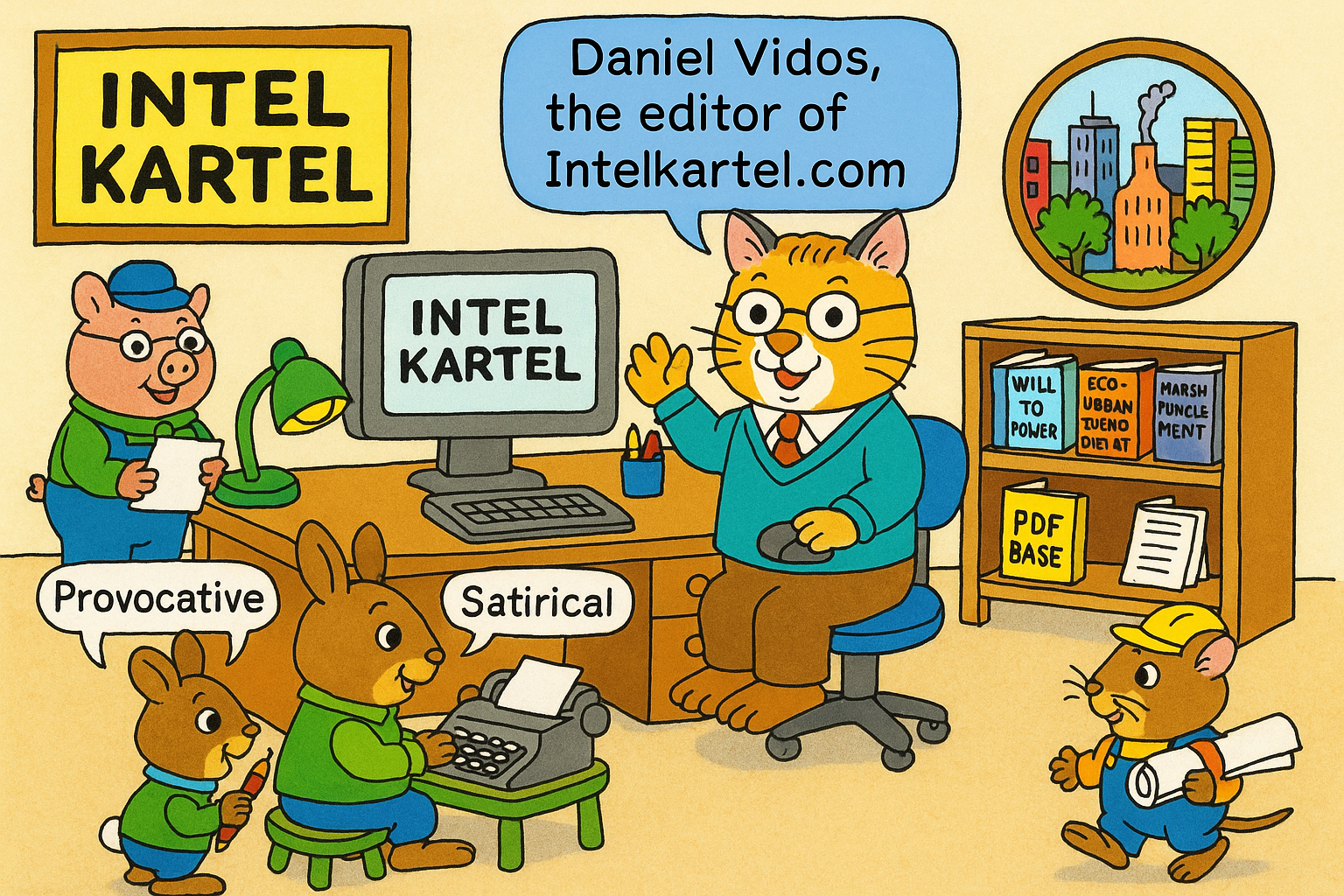
 INTEL KARTEL
Hozzászólás