CLASSIFIED ANNEX — TARGET PROCESSING PIPELINE (PRISON → EXTERNAL OPERATIONS)
DATE: 06 MARCH 2026
REF: CORRECTIONAL LAYER INTEGRATION / FLOW MODEL
CLEARANCE: SIGMA-7
1. PIPELINE OVERVIEW
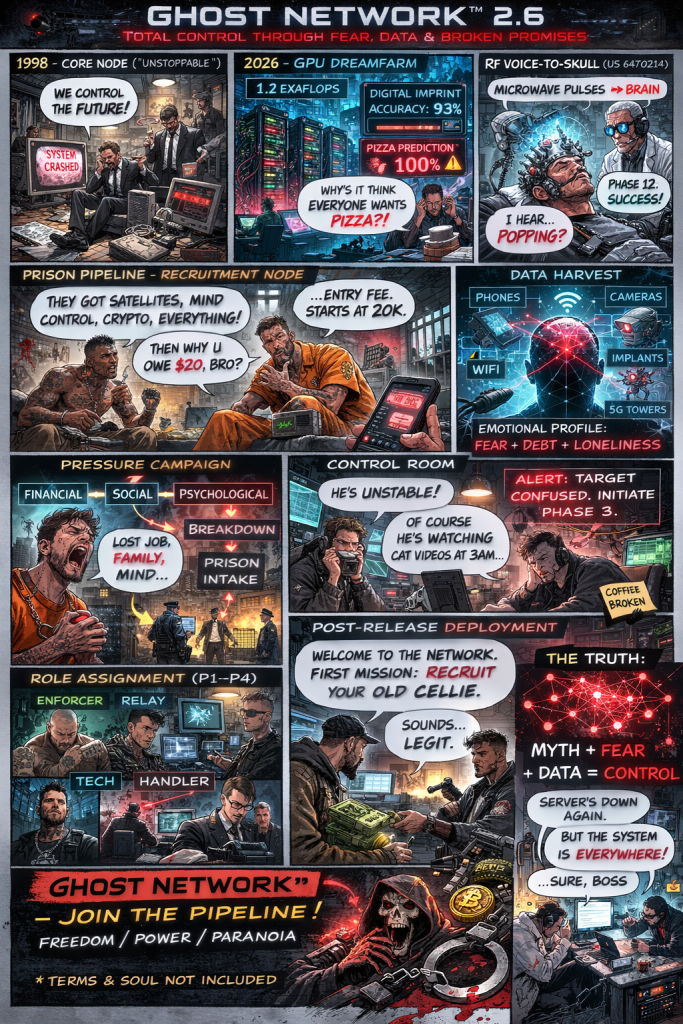
The system processes individuals through a multi-stage transformation cycle:
Civilian / Target → Observation → Pressure → Breakdown → Integration → Deployment
This cycle is iterative and self-reinforcing.
2. STAGE 0 — PRE-SELECTION (EXTERNAL WORLD)
Targets flagged via:
- Financial irregularities
- Social isolation or instability
- High reactivity to stress
- Access to networks (social, technical, economic)
Data sources:
- Digital footprint aggregation
- Behavioral prediction models
- Social graph mapping
3. STAGE 1 — INITIAL CONTACT / DISRUPTION
Objective: destabilize baseline
Methods:
- Financial pressure (loss, debt triggers)
- Social interference (conflict induction)
- Environmental stressors
Output:
Elevated anxiety + reduced stability
4. STAGE 2 — PRESSURE MODELING LOOP
while (target_resistance == active): apply_pressure_vector() observe_response() update_behavioral_model()
Pressure vectors:
- Reputation damage
- Controlled unpredictability
- Induced isolation
Goal:
Map psychological thresholds
5. STAGE 3 — CRITICAL EVENT (ENTRY POINT)
Target reaches a break condition:
- Legal incident
- Financial collapse
- Social expulsion
Result:
Entry into correctional system OR equivalent containment state
6. STAGE 4 — PRISON INTAKE PROCESSING
Inside facility:
- Subject is observed continuously
- Behavioral classification assigned (P1–P4)
- Contact established through intermediaries
Key shift:
External chaos → structured pressure environment
7. STAGE 5 — CONDITIONING
Mechanisms:
- Controlled relief (protection, resources)
- Reinforced dependency
- Narrative exposure (“system is everywhere”)
Feedback loop:
- Compliance rewarded
- Resistance punished (socially, not technologically)
8. STAGE 6 — ALIGNMENT DECISION
Subject chooses (perceived choice):
- Reject → remain under pressure
- Accept → enter pipeline
Acceptance triggers:
- Debt forgiveness
- Status elevation
- Future opportunity promise
9. STAGE 7 — ROLE ASSIGNMENT
Subject mapped to:
- Enforcer
- Relay
- Technical asset
- Handler candidate
Assignment based on:
- Observed behavior under stress
- Social influence capacity
- Cognitive profile
10. STAGE 8 — RELEASE + DEPLOYMENT
Upon release:
- Immediate contact re-established
- Tasks issued in controlled increments
- Monitoring continues via digital + social channels
11. STAGE 9 — EXTERNAL OPERATION LOOP
for each assigned_task: execute_real_world_action() collect_feedback() reinforce_or_adjust_role()
Operations include:
- Recruitment
- Pressure application
- Data acquisition
12. SYSTEM PROPERTY
The pipeline creates:
Self-propagating human infrastructure
Where each processed subject becomes:
- A node
- A recruiter
- A reinforcement mechanism
13. FAILURE CONDITION
Breakdown occurs if:
- Subject rejects belief system
- External intervention disrupts narrative
- Internal contradictions become visible
14. FINAL NOTE
The pipeline does not require advanced technology.
It requires:
- Timing
- Pressure
- Narrative control
END PIPELINE ANNEX
CLASSIFIED ANNEX — PSYCHOLOGICAL PROFILES (HANDLER vs RECRUIT)
DATE: 06 MARCH 2026
REF: HUMAN FACTORS ANALYSIS
CLEARANCE: SIGMA-7
1. OVERVIEW
The system operates on a dual-psychology model:
- Handler (control node)
- Recruit (adaptive node)
Both are products of the same environment, but diverge in perception and function.
2. HANDLER PROFILE
2.1 BACKGROUND
- Former intelligence / military / criminal leadership
- Exposure to structured systems of control
- High tolerance for ambiguity
2.2 CORE TRAITS
- Strategic thinking
- Emotional detachment
- Justification framing (“stability”, “necessity”)
- Compartmentalization
2.3 BELIEF STRUCTURE
Handlers often believe:
- They are maintaining order
- The system is larger than any individual
- Participation is unavoidable
2.4 FEAR PROFILE
- Loss of control
- Exposure of system limitations
- Replacement by younger operators
2.5 FAILURE MODE
- Overestimation of system capability
- Paranoia regarding internal betrayal
- Collapse under loss of narrative coherence
3. RECRUIT PROFILE
3.1 BACKGROUND
- High stress exposure
- Social or economic instability
- Often underestimated cognitive ability
3.2 CORE TRAITS
- Adaptive behavior
- High emotional reactivity
- Strong response to incentives and threats
3.3 BELIEF STRUCTURE
Recruits often internalize:
- System is omnipresent
- Resistance is futile
- Advancement requires compliance
3.4 MOTIVATION LAYERS
- Survival
- Status
- Financial gain
- Fear avoidance
3.5 FAILURE MODE
- Psychological overload
- Disillusionment
- Erratic behavior (risk to system integrity)
4. HANDLER–RECRUIT DYNAMIC
4.1 CONTROL MECHANISM
Handler provides:
- Structure
- Narrative
- Incentive
Recruit provides:
- Action
- Risk absorption
- Scalability
4.2 MUTUAL DEPENDENCY
- Handler needs recruit for execution
- Recruit needs handler for protection and meaning
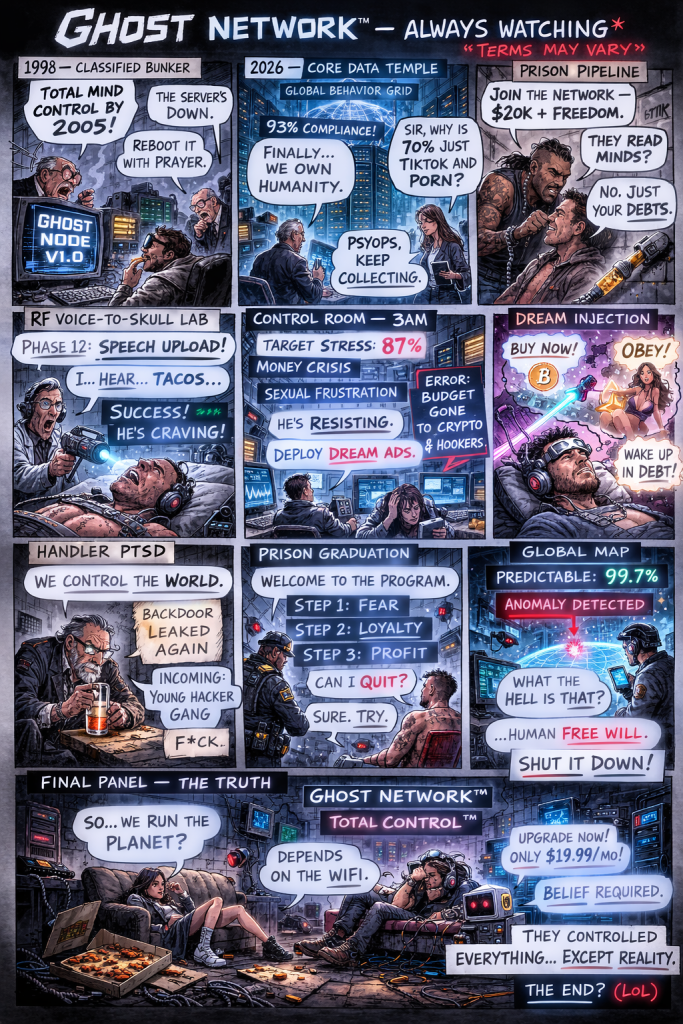
5. SHARED ILLUSION LAYER
Both parties sustain:
The belief in a larger, more powerful system than actually exists
This belief:
- Reduces resistance
- Increases compliance
- Masks structural weaknesses
6. SYSTEM STABILITY FACTOR
The system remains stable as long as:
- Handlers believe they are in control
- Recruits believe control is absolute
7. COLLAPSE CONDITION
Collapse begins when:
- Recruits question capability
- Handlers lose authority
- External reality contradicts internal narrative
8. FINAL ANALYST COMMENT
The system is not defined by technology.
It is defined by:
Human psychology under pressure
Handlers manage perception.
Recruits embody it.
END PSYCHOLOGICAL ANNEX


 INTEL KARTEL
Hozzászólás