PATENT DRAFT (SCI-FI / CONCEPTUAL)
Title
Ear–Skull Interface Communication System (“Ear-Skull Phone”) Using Resonant Neuroelectromagnetic Coupling
Abstract
A non-invasive communication system enabling direct auditory perception within a human subject without external acoustic transduction. The invention utilizes resonant low-frequency modulation combined with localized electromagnetic field shaping to induce controlled neural activation patterns in auditory processing regions. The system is designed for short-range, targeted communication between devices and human operators through wearable or proximal emitters.
1. Technical Field
This invention relates to:
- Neurotechnology
- Electromagnetic field modulation
- Human–machine interfaces
- Non-acoustic communication systems
Specifically, it concerns systems that induce perceived auditory signals directly within the human brain via controlled field interactions.
2. Background
Traditional communication systems rely on:
- Airborne acoustic waves (speakers)
- Mechanical conduction (bone conduction headphones)
Limitations include:
- Detectability
- Environmental interference
- Requirement for physical audio pathways
Emerging research suggests that neural perception may be influenced via externally applied fields, opening pathways for:
- Silent communication
- Covert signaling
- Enhanced human-machine interaction
3. Summary of the Invention
The “Ear–Skull Phone” system provides:
- Direct induction of auditory-equivalent neural signals
- No reliance on eardrum or cochlear stimulation
- Targeted field delivery using resonant frequency coupling
- Configurable modulation patterns encoding information
4. System Architecture
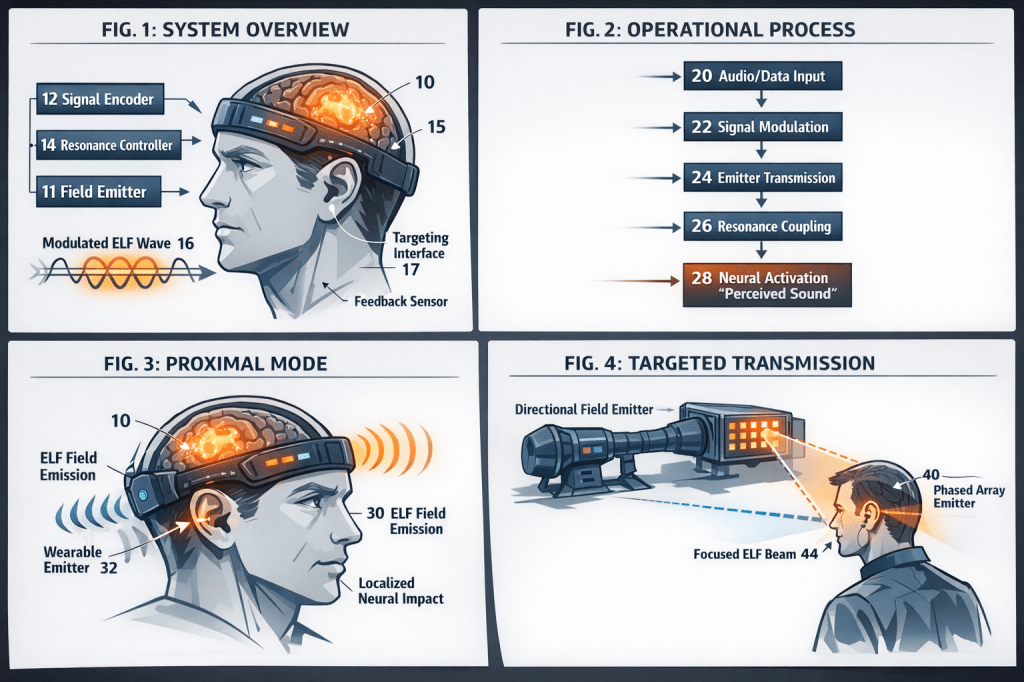
4.1 Core Components
| Component | Description |
|---|---|
| Field Emitter Unit | Generates controlled low-frequency modulated fields |
| Resonance Controller | Tunes emission to subject-specific neural response profiles |
| Signal Encoder | Converts audio/data into modulation patterns |
| Targeting Interface | Directs field toward cranial region |
| Feedback Module (optional) | Adjusts output based on detected neural response |
4.2 Operational Principle
- Input signal (voice/data) is digitized
- Signal is converted into modulated waveform patterns
- Waveforms are emitted as low-frequency coupled fields
- Fields interact with neural structures via resonance effects
- Brain interprets induced patterns as internal auditory perception
5. Modes of Operation
5.1 Proximal Mode
- Wearable device (headband, collar, or earpiece)
- Short-range, high precision
5.2 Environmental Mode
- Embedded emitters in surroundings
- Creates localized communication zones
5.3 Directed Mode
- Focused emission toward a specific individual
- Uses phased-array field steering (conceptual)
6. Signal Characteristics
| Parameter | Range (Conceptual) |
|---|---|
| Carrier Range | Extremely low to low-frequency bands |
| Modulation | Amplitude / frequency / phase hybrid |
| Encoding | Neural pattern mimicry |
| Output Level | Sub-threshold for thermal effects |
7. Claims (Conceptual)
Claim 1:
A system for inducing auditory perception in a human subject comprising:
- A field emitter configured to generate modulated electromagnetic fields
- A controller configured to encode information into said fields
- A targeting mechanism directing said fields toward the cranial region
Claim 2:
The system of Claim 1 wherein:
- The modulation patterns correspond to neural firing signatures associated with auditory perception
Claim 3:
The system of Claim 1 further comprising:
- A resonance calibration module adapting output to individual neural characteristics
Claim 4:
The system of Claim 1 wherein:
- Communication occurs without external audible sound generation
Claim 5:
A method of transmitting information comprising:
- Encoding data into modulated field patterns
- Emitting said patterns toward a subject
- Inducing perception of said data as internal auditory signals
8. Applications (Speculative)
- Silent communication in high-noise environments
- Covert operations / intelligence signaling
- Assistive technology for hearing-impaired users
- Augmented cognition interfaces
- Human–AI direct interaction
9. Advantages
- No external sound signature
- Reduced interception risk
- Direct brain-level interface
- Potential multi-channel communication
10. Limitations (In-Universe Acknowledged)
- Requires precise calibration per individual
- Signal distortion due to environmental interference
- Ethical and regulatory concerns
- Potential cognitive overload risks
11. Ethical & Regulatory Considerations
- Mandatory consent protocols
- Signal authentication requirements
- Detection and shielding standards
- International oversight recommended
12. Future Enhancements
- Bidirectional communication (brain-to-device)
- Integration with neural decoding systems
- Multi-user networked communication
- AI-driven adaptive modulation
13. Conclusion
The “Ear–Skull Phone” represents a next-generation communication paradigm, transitioning from external sensory channels to direct neural interfacing, enabling silent, efficient, and potentially transformative human communication systems.


 INTEL KARTEL
Hozzászólás