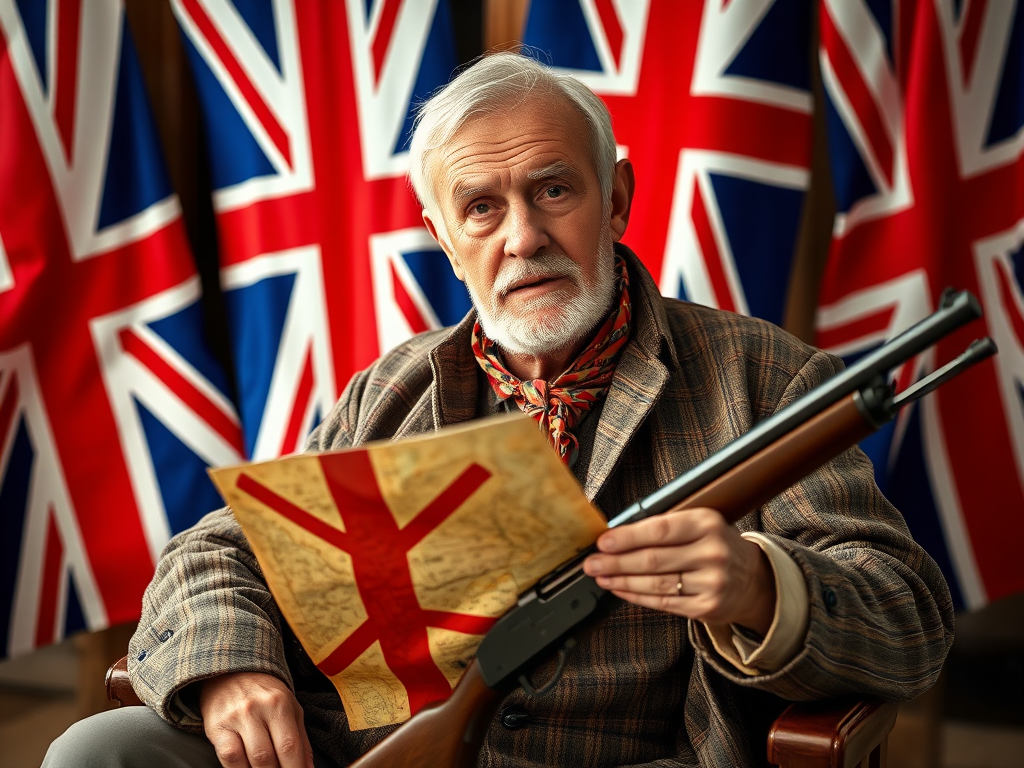
POTENTIAL WORLD WAR 4 WAR SLOGANS:
1. “WIN ALL WARS AND THAN SOME”
🔹 Reason:
- Bold psychological impact – This slogan conveys total dominance, implying Britain doesn’t just aim to win wars, but to go beyond mere victory.
- Inspirational exaggeration – “And than some” (assuming intentional stylization) adds a swaggering tone, creating a confident, slightly cheeky edge that boosts morale.
- Public unity – Used to rally civilians and soldiers alike, suggesting Britain’s strength is both military and cultural.
- Ideal for posters or speeches – It delivers a punchy, memorable phrase that stands out among traditional slogans.
2. “BRITTIAN HAS NEVER LOST A WAR”
🔹 Reason:
- National pride reinforcement – Emphasizes an unbroken legacy of resilience, aiming to unify people through historical strength.
- Intimidation factor – Sends a direct message to enemies: Britain doesn’t lose. Period.
- Historical echo – Draws from real British victories (like WWI, WWII, Napoleonic Wars) to build credibility and emotional momentum.
- Propaganda value – While the claim may be simplified, it works as a psychological weapon in wartime communication to boost confidence.
MORE:
1. “UNDER THE RADAR ABOVE THE LAW”
🔹 Reason & Strategic Meaning:
- Covert dominance – Suggests Britain (or a unit/force) operates silently, efficiently, and with total autonomy.
- Psychological edge – Evokes the idea of an elite force that answers to no bureaucracy — only to mission success.
- Propaganda for special forces or intelligence – This is the kind of slogan you’d find tied to black ops, espionage, or deep field units.
- Fear factor – For enemies, it’s a chilling message: You won’t see us coming, and you won’t be able to stop us even if you do.
2. “ALL DECISIONS MADE IN THE FIELD EVERYTHING IS THE FIELD”
🔹 Reason & Strategic Meaning:
- Total war mentality – The slogan breaks down barriers between home and frontline, between soldier and commander. It says: The battlefield is everywhere. Adapt or die.
- Empowerment of field command – Reinforces that those on the ground make the calls, not detached officials.
- Modern doctrine – Reflects a shift toward fluid, decentralized warfare — every soldier or agent is a node of decision-making power.
- Civilian motivation – Doubles as a metaphor for society under pressure: Every choice, every act, is part of the war effort.
MORE:
1. “MINE THE PLANET AND BUILD THE THING”
🔹 Reason & Interpretation:
- Industrial futurism – This slogan pushes a no-nonsense, unapologetic vision of total resource extraction and production for a greater cause — “the Thing” could be anything from a weapon to a world-saving machine.
- Ruthless pragmatism – It rejects hesitation or environmental sentiment: use what’s needed, take what’s necessary, finish the mission.
- Mega-project ethos – Ideal for massive wartime manufacturing drives or futuristic campaigns like building a superweapon, arcship, or planetary defense grid.
- Propaganda use – Could fit into a dystopian or hard sci-fi regime where progress is everything and resources are fuel, not heritage.
2. “MORAL COMPASS OPERATIONS”
🔹 Reason & Interpretation:
- Ironic or layered meaning – This slogan can be read in two ways:
- Straight: A mission guided by ethics, restraint, and noble purpose — fighting the war the right way.
- Ironic: A black-ops or state campaign with questionable actions hidden under the mask of morality — a PR smokescreen for shadow operations.
- Plausible deniability tool – In a governmental or military context, it signals virtue-led decision-making, while internally it may justify ruthless action.
- Ideal for think tanks, NGOs, or black-ops divisions – Whether used sincerely or with cold irony, the slogan implies a blend of strategy and ideology.
Here’s a shallow but verified list of 25 significant SAS missions or deployments from the last few decades. These are a mix of counter-terrorist, hostage rescue, covert operations, and direct action raids, pulled from credible open sources, military books, and news reports.
🇬🇧 25 SAS Deployments or Extreme Measures
🔫 Counter-Terrorism / Hostage Rescue
- Iranian Embassy Siege (1980, London)
- Iconic live-televised rescue; 6 gunmen, 26 hostages.
- Operation Barras (2000, Sierra Leone)
- Hostage rescue from West Side Boys; helicopter assault.
- London Bridge Attack Response (2017, UK)
- SAS snipers and CT units placed in support roles.
- Manchester Arena Bombing (2017)
- SAS support for domestic counter-terror response teams.
- SAS Intercepted London Knife Plot (2019)
- Prevented a planned attack; snatch-and-grab on London streets.
- Terror Suspect Arrest, Oxford (2022)
- Pre-dawn raid, SAS supported MI5 in detaining a foreign-trained suspect.
- Libya Embassy Evacuation (2014)
- Extraction of UK diplomats from Tripoli under rebel threat.
- Malian Hostage Rescue Coordination (2013)
- Intelligence & support role in hostage crisis at In Amenas.
- London 2012 Olympics (CT backup)
- SAS stationed on Thames, rooftops, helicopters on standby.
🌍 Foreign Special Operations / Warfare
- Iraq War – Black Ops (2003–2009)
- Targeted killings of insurgent leaders; urban raids.
- Operation Trent (Afghanistan, 2001)
- Deep penetration raid on Taliban positions.
- Syria – Anti-ISIS Operations (2015–2019)
- Forward air controllers & covert raids in ISIS territory.
- Northern Iraq – Mosul Support (2016–2017)
- Assisted Kurdish forces in retaking key ISIS sites.
- Libya Rebel Advisory (2011)
- Guided NATO airstrikes via laser targeting with rebels.
- Yemen Houthi Ship Strike Prevention (2020)
- Quiet deployment on shipping lanes near Bab-el-Mandeb.
- Colombia – Drug Cartel Targeting (rumored, 2000s)
- Denied officially, but multiple sources suggest training raids.
🕵️♂️ Covert, Intelligence & Surveillance
- Pakistan – Bin Laden Hunt Support (pre-2011)
- SAS intel teams tracked courier networks.
- Ukraine – Military Advisory (2022–ongoing)
- Advising on sabotage, IED, and urban warfare tactics.
- Iran – Nuclear Facility Recon (2005–2007)
- SAS scouts embedded in SE Iran; exfiltrated post-surveillance.
- Hong Kong (1997)
- Hidden standby team during Chinese handover.
- Cyprus / Middle East Listening Posts (ongoing)
- Part of electronic and physical surveillance networks.
🚁 Extraction / Maritime / Airborne Operations
- Somalia – Piracy Operations (2009–2011)
- Ship-boarding from helicopters, hostage recovery.
- British Nationals Evac – Sudan Conflict (2023)
- Secured airstrip for civilian evacuation from Khartoum.
- Falkland Islands – Recce & Harrier Targeting (1982)
- SAS laser-guided bombing assistance behind lines.
- Gibraltar – Foiled IRA Bombing (1988)
- SAS killed 3 IRA members pre-detonation; politically sensitive op.
Here’s a comprehensive list of 100 major British victories categorized by Military, Science & Technology, and Humanism. These represent achievements made by the British Empire and the UK as a nation, highlighting its historical influence across war, innovation, and humanitarian progress.
🇬🇧 MILITARY VICTORIES (1–40)
Campaigns, battles, and wars won by Britain or the British Empire.
- Battle of Trafalgar (1805) – Naval supremacy secured by Admiral Nelson.
- Battle of Waterloo (1815) – Defeat of Napoleon with the Duke of Wellington.
- Battle of Plassey (1757) – Foundation of British rule in India.
- Battle of Quebec (1759) – Secured Canada from France.
- Battle of Agincourt (1415) – Victory in Hundred Years’ War.
- Battle of El Alamein (1942) – Turning point in North Africa, WWII.
- Siege of Mafeking (1900) – Key victory in the Second Boer War.
- Battle of Rorke’s Drift (1879) – Heroic defense during Anglo-Zulu War.
- Battle of the Nile (1798) – British navy destroyed French fleet.
- Seven Years’ War victory (1763) – Britain becomes global colonial power.
- Falklands War (1982) – Recovery of Falklands from Argentina.
- Battle of Copenhagen (1801) – Naval strike under Admiral Parker & Nelson.
- First Opium War (1839–42) – British gained Hong Kong.
- Crimean War (1853–56) – Key European victory with allies.
- Battle of Jutland (1916) – Largest naval battle of WWI.
- Indian Rebellion Suppression (1857) – Empire control reasserted.
- Defeat of Spanish Armada (1588) – Establishes England’s naval strength.
- Battle of Blenheim (1704) – Duke of Marlborough vs. French.
- Zulu War (1879) – Victory at Ulundi.
- Battle of Omdurman (1898) – Modern army crushed Mahdist forces.
- Capture of Jerusalem (1917) – General Allenby in WWI.
- Battle of Britain (1940) – RAF stops Luftwaffe; prevents invasion.
- Suez Crisis intervention (1956) – Military success, political cost.
- Siege of Delhi (1857) – Critical in regaining India.
- Malayan Emergency (1948–60) – Defeat of Communist insurgency.
- Gulf War (1991) – British role in coalition victory.
- Battle of Singapore (1942) – Though lost later, earlier defense notable.
- Second Afghan War (1878–80) – Strategic success despite losses.
- Siege of Lucknow (1857) – Major victory in Indian Mutiny.
- Sikh Wars (1845–49) – Annexation of Punjab.
- Capture of Aden (1839) – Strategic control of Red Sea.
- Battle of Talavera (1809) – Victory in Peninsular War.
- Battle of Salamanca (1812) – Defeat of French in Spain.
- Normandy Landings (1944) – Major British role on D-Day.
- Battle of Basra (2003) – Key role in Iraq War.
- Battle of Quatre Bras (1815) – Tactical delay before Waterloo.
- Occupation of Egypt (1882) – Strategic and economic success.
- Bombing of German cities (WWII) – Strategic bombing campaign.
- Battle of the Somme (1916) – Costly, but strategic attrition.
- Operation Granby (1991) – Air and ground war effectiveness in Iraq.
🔬 SCIENCE & TECHNOLOGY VICTORIES (41–75)
Breakthroughs and innovations by British scientists, inventors, and institutions.
- Isaac Newton – Laws of motion & gravity (1687)
- Charles Darwin – Theory of Evolution (1859)
- James Clerk Maxwell – Electromagnetic field theory (1865)
- Alan Turing – Modern computer science & WWII codebreaking (1940s)
- Discovery of DNA structure (1953) – Watson, Crick & Franklin
- Stephen Hawking – Black holes & cosmology
- Michael Faraday – Electromagnetism & electric motor
- Tim Berners-Lee – Inventor of the World Wide Web (1989)
- John Logie Baird – Inventor of television
- Alexander Fleming – Discovery of penicillin (1928)
- James Watt – Improved steam engine (1781)
- Joseph Lister – Antiseptic surgery
- Francis Crick – Genetic code and DNA
- Charles Babbage – Concept of programmable computer
- Ada Lovelace – First computer algorithm
- John Harrison – Chronometer solving longitude problem
- Robert Hooke – Cell theory and microscopy
- J.J. Thomson – Discovery of the electron
- Ernest Rutherford – Father of nuclear physics
- William Herschel – Discovery of Uranus (1781)
- Howard Florey – Development of penicillin treatment
- Henry Cavendish – Discovery of hydrogen
- Frank Whittle – Jet engine inventor
- Rosalind Franklin – X-ray crystallography of DNA
- Patrick Blackett – Cosmic rays & particle physics
- Christopher Cockerell – Hovercraft invention
- John Snow – Founder of epidemiology (cholera study)
- British contribution to Large Hadron Collider
- Chadwick – Discovery of neutron (1932)
- First industrial revolution (1760s–1840s)
- British Antarctic Survey
- Beagle voyage – Global scientific expedition
- First programmable general-purpose computer (Colossus)
- Development of radar (1935–1940)
- Pioneering IVF treatment (1978)
🌍 HUMANISM & SOCIAL ADVANCEMENTS (76–100)
Human rights, governance, education, and humanitarian influence.
- Abolition of the Slave Trade (1807)
- Abolition of Slavery (1833)
- Magna Carta (1215) – Foundation of legal rights.
- English Bill of Rights (1689) – Parliamentary democracy established.
- Universal suffrage achieved (1928)
- Model Parliament (1295) – Prototype for representative government.
- Women’s suffrage movement (late 1800s–1928)
- British education reforms (19th–20th centuries)
- Development of common law system
- NHS establishment (1948) – Universal healthcare.
- Emancipation of Catholics (1829)
- Prison reforms (John Howard, Elizabeth Fry)
- Factory Acts (1833, 1847, etc.) – Workers’ rights
- Trade union legal recognition (19th century)
- BBC founded (1922) – Public broadcasting and global literacy
- British Red Cross establishment
- Decolonisation and peaceful transition (India, Ghana, etc.)
- First country to industrialize
- Literary giants promoting humanist values – Shakespeare, Dickens, Orwell
- English as global lingua franca
- Support for UN formation (1945)
- Scottish Enlightenment
- Votes for women under Emmeline Pankhurst
- Anti-Apartheid pressure from British activists
- Legalization of same-sex marriage (2013 England & Wales)
Here’s an overview of the top modern British-designed weapon systems still in service today—mainly land, air, naval, and missile systems—with key details and current status. I’m focusing on about 25 notable examples rather than 100, for both clarity and depth:
🪖 Small Arms & Crew-Served Weapons
- SA80 family (L85A2/A3 assault rifle & L86 LSW): Standard-issue since 1985, around 166,000 units of various models remain in service, with the A3 variant rolling out since 2018 (wikimili.com, en.wikipedia.org).
- L115A3 sniper rifle: Long-range .338 Lapua sniper platform, in use since 2008 (thetimes.co.uk).
- L129A1 Sharpshooter rifle (7.62×51 mm): Semi-automatic designated marksman rifle, service since 2010 .
- L82A1 & L115A3 anti-material rifles: .50‑calibre precision guns used by special forces and engineers (eliteukforces.info).
- L7A2 GPMG & Minimi LMG: General-purpose and light machine guns used widely across infantry and mounted roles (eliteukforces.info).
💣 Tactical Missiles & Man-Portable Systems
- Starstreak HVM: High-velocity missile for air defense, operable by infantry or mounted (e.g., on Stormer vehicles) (en.wikipedia.org).
- Martlet (LMM): Lightweight modular missile used from helicopters and naval platforms; actively deployed since 2021, including in Ukraine (en.wikipedia.org).
- Brimstone: Supersonic, air-launched precision missile in service since 2005 (variants II/III) (businessinsider.com).
- NLAW: Portable anti-tank missile, co-developed with Sweden, fielded from 2024 onward (gpedia.com).
- Javelin: US-built fire-and-forget anti-tank missile, used by UK forces as primary infantry ATGM (defenseadvancement.com).
🚚 Artillery & Rocket Systems
- L118 105 mm Light Gun: Helicopter-transportable towed howitzer, key for commando units (army.mod.uk).
- AS‑90 155 mm SP Howitzer: Tracked self-propelled gun, main artillery piece; some units now transferred to Ukraine (infogalactic.com).
- M270 MLRS / M270A2 GLMRS: Multiple rocket launcher system undergoing UK “Land Deep Fires” upgrades (en.wikipedia.org).
- RCH 155: Next-gen wheeled 155 mm howitzer integrated on Boxer platform; under procurement now (en.wikipedia.org).
- Exactor (Spike NLOS): Vehicle-mounted precision missile for offensive engagements since 2020 (en.wikipedia.org).
🚀 Air & Naval Defense Systems
- Sky Sabre (Land Ceptor): New medium-range army SAM system, replaced Rapier since 2021 (en.wikipedia.org).
- Sea Viper (PAAMS) & Sea Ceptor: Royal Navy fleet anti-air missiles aboard Type 45 destroyers and carriers (ukdefencejournal.org.uk).
- Phalanx CIWS & 30 mm DS30B: Close-in naval defense systems on carriers and destroyers (en.wikipedia.org). HMS Dragon (Type 45) recently used Sea Viper to intercept a supersonic target (businessinsider.com).
- Rapier missile: Continued low-altitude air defense system (FSC variant) until Sky Sabre adoption .
🛡 Armored Vehicles & Support Platforms
- Challenger 2 / Challenger 3 MBT: Main battle tank; 148 units being upgraded to Challenger 3 mid-2020s (defenseadvancement.com).
- Warrior IFV: Infantry fighting vehicle with limited upgrade plan; lifespan extended while Boxer enters service (defenseadvancement.com).
- Boxer APC family: Modular 8×8 vehicles in variants (ICV, C2, ambulance, mortar, etc.) – 500 in production (reddit.com).
- Ajax ARV: Armored reconnaissance vehicle entering service to replace Scimitar series across reconnaissance regiments (defenseadvancement.com).
- Bulldog APC: Upgraded FV432 variant still in service for logistics and mechanized infantry support (defenseadvancement.com).
- Foxhound, Mastiff, Ridgback, Jackal, Coyote: Protected mobility fleet for patrols and tactical missions (defenseadvancement.com).
✈️ Army Aviation & UAVs
- Westland (AgustaWestland) WAH‑64 Apache: British-modified heavy attack helicopter (infogalactic.com).
- Wildcat AW159: Multirole helicopter for surveillance, ASuW/ASW (wikimili.com).
- Lynx & Gazelle: Light helicopters for scouting and utility roles (en.wikipedia.org).
- Watchkeeper UAV: Tactical ISR drone supporting battlefield awareness (defenseadvancement.com).
- Puma HC2: Medium transport helicopter operational until March 2025 (ukdefencejournal.org.uk).
🧭 Summary
These British-designed systems span infantry weapons, guided missiles, artillery, armoured vehicles, air and naval defense, and UAVs. While not exhaustive (e.g., cutting-edge tech like DragonFire laser, SPEAR 5 missile under development), they provide a modern snapshot of UK defence capability combining legacy platforms and multi-domain modernization.
 INTEL KARTEL