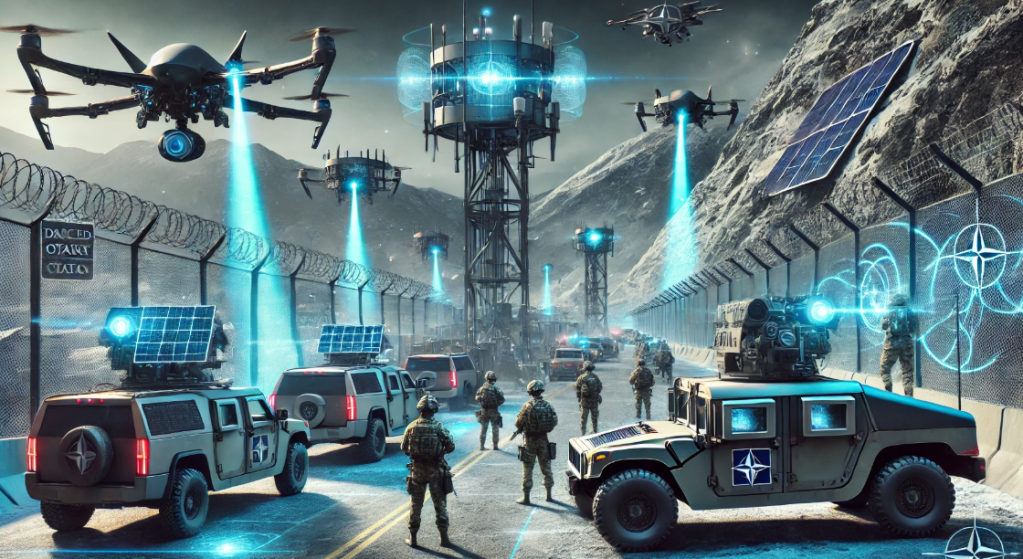
Military Intelligence Memorandum
Subject: Directed Energy Weapons (D.E.W.) in Border Defense and Strategic Deterrence
Classification: Top Secret
Date: [Insert Date]
To: Commanding Officers and Strategic Planning Units
From: [Your Name], Military Intelligence Division
Introduction
This memorandum explores the integration of Directed Energy Weapons (D.E.W.) into border defense systems, with a specific focus on NATO borders. It also examines the broader implications of D.E.W. for achieving strategic deterrence and the theoretical end of conventional warfare through the application of overwhelming force.
D.E.W. Applications in Border Defense
1. Patrolling and Surveillance
D.E.W. systems, including high-energy lasers and microwave weapons, can serve as non-lethal and lethal deterrents along borders. Key applications include:
- Remote Target Neutralization: D.E.W. can disable intruding drones, vehicles, and electronic devices without the need for physical engagement.
- Enhanced Surveillance: Integration with advanced radar and sensor networks allows D.E.W. systems to detect and engage threats in real-time.
- Non-lethal Crowd Control: Microwave-based Active Denial Systems (ADS) can disperse unauthorized gatherings without causing permanent harm.
2. Counter-Insurgency and Threat Elimination
NATO borders face persistent threats from insurgents, traffickers, and hostile state actors. D.E.W. provides a precise, scalable response:
- Precision Strikes: Lasers can destroy specific targets (e.g., ammunition depots, weaponized UAVs) without collateral damage.
- Jamming and Disabling Communications: High-powered microwave weapons can disrupt enemy communication networks, rendering them inoperative.
Strategic Implications for Deterrence
1. Overkill Potential
The overkill potential of D.E.W. lies in its capability to eliminate entire operational infrastructures. The deployment of such overwhelming power can:
- Dissuade Aggression: Adversaries are less likely to provoke conflicts when faced with technologically superior and precise deterrents.
- Minimize Conventional Engagement: The ability to disable an opponent’s command and control systems precludes the need for large-scale troop deployments.
2. End to Conventional Warfare
D.E.W. represents a paradigm shift in military strategy:
- Decisive Neutralization: Swift incapacitation of adversary forces and infrastructure would render prolonged conflict unsustainable.
- Technological Supremacy: By achieving unchallenged superiority, NATO could force adversaries to the negotiating table, reducing the likelihood of war.
Challenges and Considerations
- Ethical Concerns: The use of D.E.W. for overkill applications raises questions about proportionality and adherence to international laws.
- Countermeasures: Adversaries may develop shielding or counter-D.E.W. technologies, necessitating continuous innovation.
- Collateral Risks: Unintended disruption of civilian systems (e.g., power grids, communication networks) must be mitigated through rigorous targeting protocols.
Recommendations
- Pilot Programs: Deploy prototype D.E.W. systems along high-risk NATO borders to assess operational effectiveness.
- Research and Development: Invest in advanced D.E.W. technologies, focusing on power scaling, precision targeting, and miniaturization.
- Rules of Engagement: Develop comprehensive legal and ethical frameworks for the deployment of D.E.W.
- Diplomatic Strategy: Use D.E.W. capabilities as a bargaining tool in peace negotiations, emphasizing their role in deterrence rather than aggression.
Conclusion Directed Energy Weapons hold transformative potential for border defense and global security. Their integration into NATO’s strategic arsenal could deter hostile actions, neutralize threats with precision, and ultimately render conventional warfare obsolete. However, careful implementation and adherence to international norms are crucial to their success.
Prepared by: [Your Name]
Military Intelligence Division




















 INTEL KARTEL