VD Military Intelligence Report
Subject: Strategic Assessment – Risks of a Decapitation Campaign Against the Russian Federation
Date: 08 March 2026
Classification: Top Secret / Eyes Only
1. Executive Summary
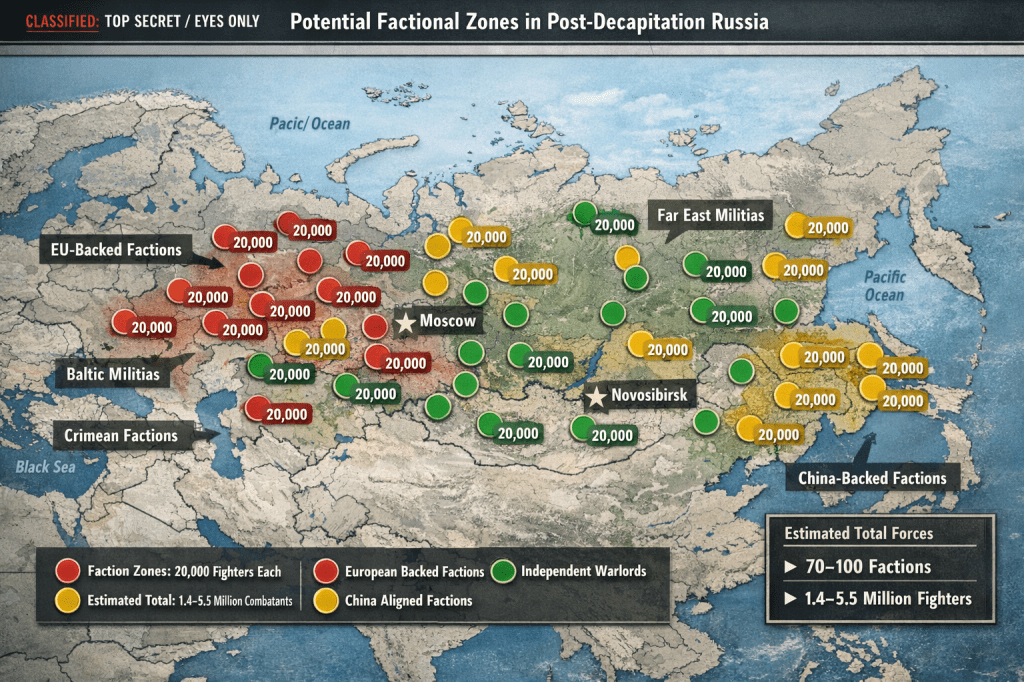
A decapitation strategy targeting the leadership of the Russian Federation could trigger the collapse of centralized authority, leading to a large-scale fragmentation of military and paramilitary forces. Intelligence estimates indicate the emergence of 70–100 armed factions, each averaging ~20,000 combatants, resulting in 1.4–5.5 million armed personnel collectively.
These factions would compete internally for survival, territorial control, and political leverage, while neighboring powers such as China and European states may attempt to exploit the instability for strategic and economic gain.
Without preemptive stabilization, such an operation risks regional destabilization, opportunistic resource capture, uncontrolled armed conflict, and global security threats.
2. Factional Landscape Post-Decapitation
- Internal Russian Factions:
- Military splinters, paramilitary groups, oligarch-aligned private armies, and regional separatist militias (Siberia, North Caucasus, Far East).
- Each faction ~20,000 personnel.
- External Opportunistic Actors:
- Neighboring European states seeking border influence.
- Chinese paramilitary or proxy forces securing strategic resources.
- Private military contractors engaging for profit or leverage.
- Total Forces:
- 70–100 factions.
- Combined force: 1.4–5.5 million armed personnel.
- Objectives:
- Immediate survival, territorial control, control of strategic resources, and negotiation power with foreign actors.
3. Regional and Global Impact
- Europe: Potential refugee influx, illicit arms proliferation, and hybrid warfare scenarios along the borders.
- China: Strategic positioning in the Russian Far East to secure resources and buffer zones.
- Global Security: Threats to energy infrastructure, nuclear command integrity, cyber operations, and global markets.
4. Risks of Decapitation Strategy
- Power Vacuum: Rapid collapse of central governance could lead to internecine conflict among millions of combatants.
- Looting & Resource Capture: Factions may seize energy, industrial, and military infrastructure.
- Factional Proliferation: Autonomous military forces operating with minimal coordination make stabilization nearly impossible.
- Escalation Risk: Neighboring powers may intervene opportunistically, potentially sparking wider regional war.
- Negotiation Instability: Fragmented authority reduces the likelihood of a unified post-conflict settlement.
5. Mitigation Strategies
- Pre-Position Stabilization Forces:
- Deploy rapid-response multinational contingents with clear rules of engagement.
- Secure critical supply nodes to prevent uncontrolled looting.
- Controlled Decentralized Engagement:
- Identify and negotiate with key faction leaders in advance.
- Offer incentives for cooperation to minimize inter-factional conflict.
- Secure Critical Infrastructure:
- Protect energy grids, nuclear facilities, transportation hubs, and urban centers.
- Isolate high-value assets from opportunistic seizure.
- Information Operations & Psychological Campaigns:
- Communicate post-decapitation governance frameworks to reduce chaos and prevent false claims to power.
- Counter disinformation that could inflame conflict between factions.
- Post-Conflict Governance Framework:
- Establish transitional governing councils representing recognized military and civil authorities.
- Coordinate international aid to prevent competition over scarce resources and humanitarian crises.
6. Conclusion
A decapitation operation against Russia carries extremely high operational and geopolitical risk. Fragmentation could unleash over a million armed personnel across dozens of factions, threatening stability across Europe and Asia.
Recommendation: Avoid decapitation unless comprehensive post-collapse stabilization and international governance frameworks are in place. Alternative strategies focusing on containment, selective targeting, and diplomatic leverage are advised.




Vélemény, hozzászólás?