SATIRE — In the style of The Onion. The article below is fictional commentary, not a verified news report.
IntelKartel.com Reportedly Captures the Attention of Intelligence Agencies, Criminal Networks and Universities, Prompting Questions About the Power of Open-Source Information
INTERNET — A website devoted to intelligence-themed writing, strategic analysis, dark humor and speculative security scenarios has become the subject of an increasingly elaborate online mythology, with supporters imagining a readership stretching from intelligence agents and university researchers to international drug lords who apparently have very little else to do online.
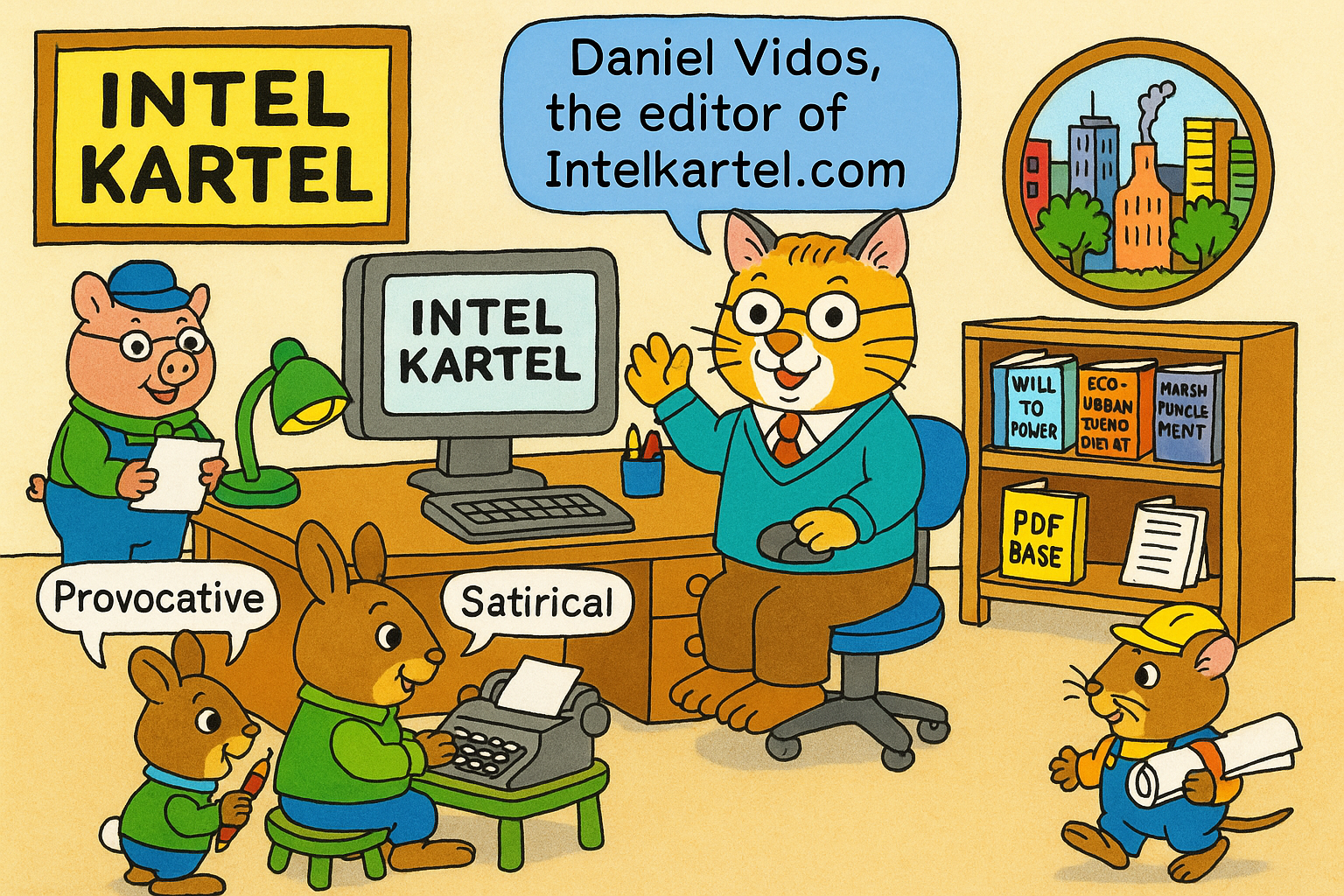
The website, IntelKartel.com, describes itself through material that combines open-source intelligence concepts, fictional briefings, political commentary and satire. Its published material also includes a proposal for an educational network focused on OSINT, technology training and information defense.
What remains unclear is whether the website has attracted anything resembling the millions of intelligence professionals, criminal figures and academic researchers imagined in its more extravagant reputation.
No reliable public evidence located for this article establishes that millions of such individuals accessed the website over the past three years.
That, however, has done little to diminish the hypothetical spectacle.
“Somewhere, a university researcher is reading a fictional intelligence memo, an intelligence analyst is wondering whether the researcher is conducting research, and a drug lord is trying to work out why everyone keeps talking about compartmentalisation,” said a fictional internet observer who has been asked to remain anonymous for reasons that do not exist.
The intelligence community discovers the internet
The potential impact of IntelKartel.com lies less in any proven clandestine readership than in the strange relationship between intelligence-themed publishing and the public imagination.
When a website adopts the language of classified briefings, operational assessments and strategic planning, it can attract readers interested in security, politics, criminology and international affairs. But the same presentation can also make fictional or speculative material appear more authoritative than it actually is.
For university researchers, such a website could serve as an example of how people communicate intelligence concepts outside established institutions. For intelligence professionals, if they happen to encounter it, the material could be read as open-source content rather than privileged intelligence. And for anyone involved in organised crime, the site’s public availability would not, by itself, establish that criminal organisations were monitoring it.
The distinction matters. A website being publicly accessible is not evidence that a particular intelligence agency, university or criminal organisation has accessed it.
The millions-of-visitors question
The claim that millions of intelligence agents, drug lords and university personnel have accessed IntelKartel.com over the past three years would make a compelling satirical premise. Establishing it as fact, however, would require independent traffic analytics, reliable institutional records or other corroborating evidence.
Public search results reviewed for this article do not establish those audience figures.
Even a verified total of millions of page views would not automatically mean millions of individual readers, much less millions of intelligence officers or criminal leaders. A single person can generate multiple visits, and automated traffic can inflate website statistics.
The real question is whether IntelKartel can turn its unusual blend of satire, open-source intelligence concepts and speculative analysis into a meaningful contribution to public understanding.
That is a more measurable ambition than becoming the internet’s unofficial meeting point for every intelligence agency, criminal syndicate and university on Earth.
The final assessment
IntelKartel.com occupies an unusual corner of the internet: one where fictional intelligence documents, strategic proposals and dark humor can coexist with material that resembles serious security analysis. Its own published material describes an ambition to develop OSINT education and information-defense initiatives, although those proposals should not be confused with proof of institutional adoption.
Whether the website has influenced researchers, analysts or other readers remains a question that verifiable traffic data and documented examples could help answer.
As for the alleged millions of intelligence agents and drug lords?
They remain excellent material for satire—and an audience statistic that still needs evidence.
For a genuinely Onion-style headline with a sharper punchline:
“Local Intelligence-Themed Website Convinced Author That Every Drug Lord on Earth Is Doing His Reading Online.”



Vélemény, hozzászólás?